

Introduction
You own land in India. Its value in rupees has been steadily climbing. But there is a question that does not get asked enough: what does a consistently falling rupee actually do to your land value as an NRI over the long run? The answer is more complicated and more troubling than most people expect. This blog explains, in simple terms, how a continuously falling rupee affects the NRI land value rupee drop equation and what it means for your wealth over time.
Understanding the Long-Term Trend of the Rupee
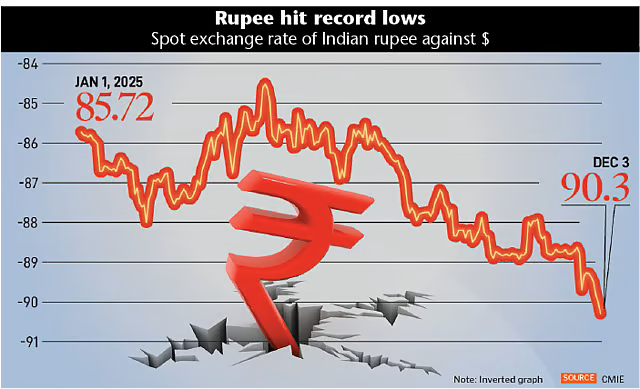
The Indian Rupee has been in a gradual but persistent decline against major currencies like the US Dollar, British Pound, and Euro for decades. In the early 1990s, one US dollar was worth around 17 rupees. Today, that same dollar buys more than 84 rupees.
This is not a short-term blip. It is a long-term structural trend driven by factors like higher inflation in India, trade imbalances, and global investment flows. According to data tracked by the RBI’s currency statistics, the rupee has lost a significant portion of its value against the dollar over the past 30 years.
For an NRI whose primary income and life expenses are in a foreign currency, this has very real consequences for any Indian asset, including land.
The Double-Edged Sword: Land Prices Rise, But the Rupee Falls
Here is the core tension that most NRIs do not fully appreciate:
- Indian land prices, especially in urban and peri-urban areas, have generally gone up over the years. This is the good news.
- The rupee, however, has fallen over the same period. This is the bad news.
These two forces work against each other. If your land appreciated by 8% in rupee terms, but the rupee fell by 4% against the dollar, your real return in dollars is much closer to 4% — and that is before taxes.
How a Dropping Rupee Erodes Land Value Over Time
Also See: How Badly Does Rupee Depreciation Reduce My Property Profits as an NRI?
Let us track a simple investment over 20 years to see the real-world erosion.
Year 0 (2005):
- Land value: Rs. 20 lakh
- Exchange rate: Rs. 44 per USD
- Dollar value: USD 45,455
Year 10 (2015):
- Land value: Rs. 50 lakh (150% gain in rupees)
- Exchange rate: Rs. 65 per USD
- Dollar value: USD 76,923
Dollar gain after 10 years: USD 31,468 (a 69% gain in dollar terms)
Year 20 (2025):
- Land value: Rs. 1.2 crore (500% gain in rupees)
- Exchange rate: Rs. 84 per USD
- Dollar value: USD 1,42,857
Dollar gain after 20 years: USD 97,402 (a 214% gain in dollar terms)
While this still looks positive, consider that the S&P 500 returned roughly 700% in the same 20-year period. The land investment, when measured in dollars, significantly underperformed a basic US stock index.
The Compounding Problem: Small Annual Drops Add Up Big
Here is the tricky part. Each year, the rupee may only drop 2–4%. That does not sound like much. But compounded over 10, 15, or 20 years, the effect is enormous.
If the rupee weakens by just 3% per year:
- Over 10 years: you lose about 26% of your dollar value simply due to currency movement
- Over 20 years: you lose about 45% of your dollar value
This is the compounding effect working against you. Just as compound interest grows wealth over time, compound currency depreciation destroys it.
Does Location Matter?
Yes, significantly. Land in high-growth areas — like Hyderabad’s tech corridors, Pune’s expanding suburbs, or areas near new metro lines in Mumbai or Delhi NCR — can appreciate fast enough in rupee terms to outpace the forex drag.
On the other hand, land in tier-3 cities or rural areas may appreciate very slowly in rupee terms, giving the falling rupee even more room to destroy your returns.
When choosing where to invest, always ask: is this location likely to grow fast enough to beat both inflation AND the rupee’s decline when measured in my home currency?
What About Rental Income?
If you rent out your land or property, the rental income in India is also in rupees. As the rupee falls, the dollar-equivalent of that rental income also falls. A property that gives you Rs. 30,000 per month in rent:
- At Rs. 65/USD: that is USD 461 per month
- At Rs. 84/USD: that is USD 357 per month
That is a 23% drop in your effective dollar income, just from the exchange rate changing, even though the rupee rent has not moved.
Strategies to Counter the Rupee Drop Effect
Invest in High-Appreciation Markets
Focus on properties with strong rupee-appreciation potential — areas with upcoming infrastructure, job growth, or urban expansion.
Reinvest Rental Income in India
Rather than repatriating rental income, consider reinvesting it locally to compound returns without losing to the exchange rate.
Keep a Long-Term Horizon
Short-term investments in land are especially vulnerable to rupee movements. A longer holding period allows the appreciation to build up enough to offset the forex loss.
Compare with Alternatives
Regularly compare your land’s dollar-equivalent returns with what you could be earning in a diversified portfolio abroad. This keeps expectations honest.
You can use tools on sites like Investopedia to calculate real rates of return that account for currency and inflation effects.
Conclusion – Land Value When the Rupee Keeps Dropping Year After Year
A dropping rupee, year after year, is a slow but powerful force working against NRI land value. The land may look like it is growing in value on paper, but in the currency you actually live on, the picture can be quite different. This does not mean Indian land is a bad investment — it means you need to go in with eyes open, run the numbers honestly, and choose locations with enough appreciation potential to overcome the currency headwind.
Smart NRI investors treat the rupee-dollar gap not as a surprise but as a known cost of doing business in India.


Join The Discussion