.png)
State guide
Farmland in Punjab
India's grain economy, with a global diaspora — open to every buyer, but only if the parcel isn't village common land.
23
Districts
~83%
Net Sown Area
Open to All Buyers
Access
PLRS
Records Portal
State land record — Punjab
Rev. 2026 · Farmland India desk
Divisions
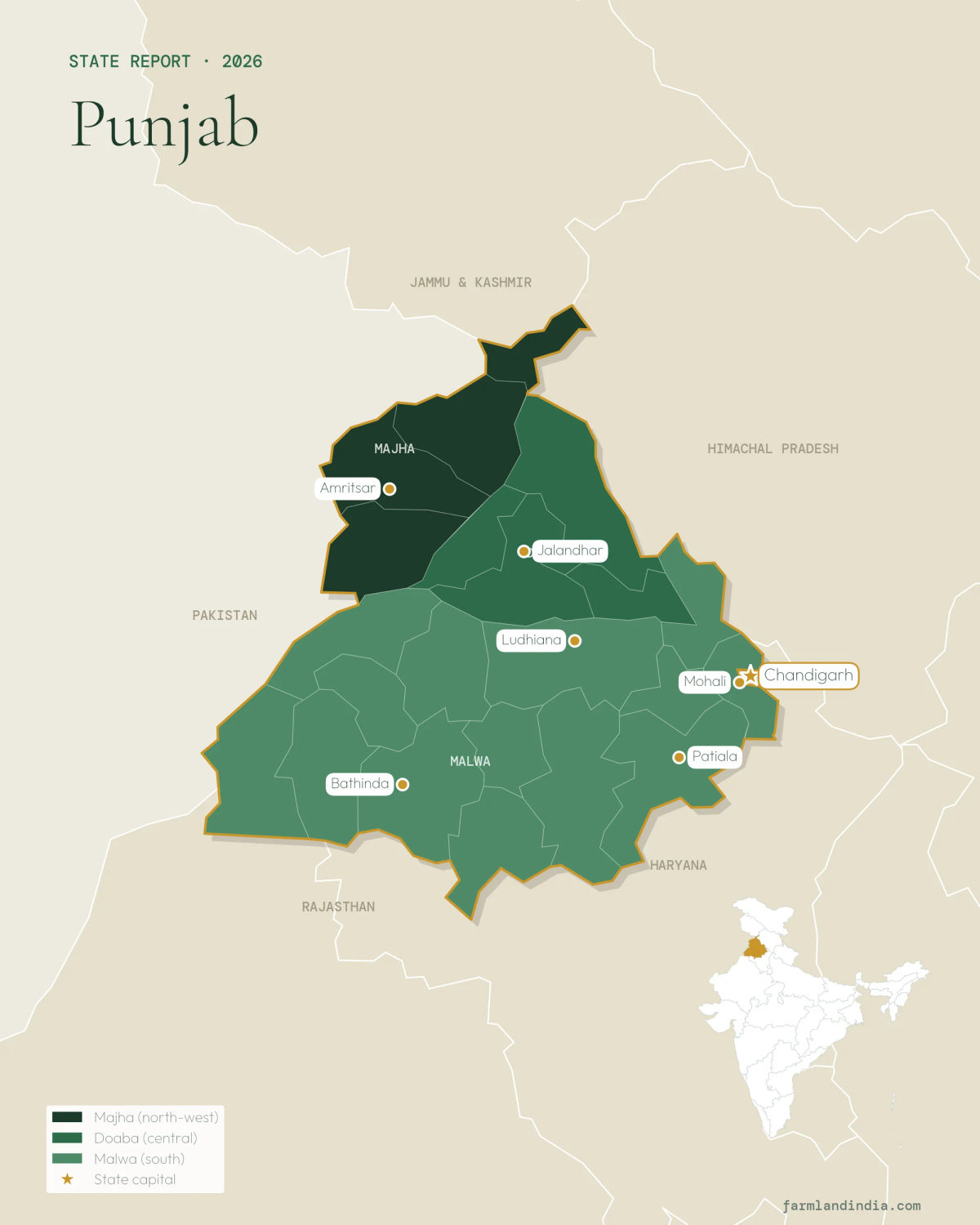
5 (Patiala · Rupnagar · Jalandhar · Ferozepur · Faridkot)
Total districts
23
State area
~50,362 sq km
Net sown area
~83% of state area
Land records portal
PLRS / Jamabandi Punjab
Governing act
Punjab Land Reforms Act, 1972
Stamp duty (M/F)
7% / 5% + 1% SSF + 1% reg
Collector rates
Revised up to 145%, Oct 2024
Punjab — land purchase legal rules
✓ Punjab is open to all Indian citizens with no non-agriculturist bar. The real diligence work here is verifying land classification — specifically ruling out Shamlat Deh (village common land), which cannot legally be sold at all.
Who can buy agricultural land? Any Indian citizen, subject to standard ceiling and documentation requirements under the Punjab Land Reforms Act, 1972 (Act No. 10 of 1973). No domicile or occupation test applies to non-Shamlat land.
Ceiling limits: a family unit may retain up to 18 standard acres of first-quality irrigated land, or up to 25 acres of unirrigated/semi-irrigated land. A 2017 amendment allows land accumulated for non-agricultural purposes (industrial, institutional, commercial) to be exempted from the ceiling via self-certification to the Collector.
Shamlat Deh — the parcel that cannot be sold: village common land (Shamlat Deh) is vested in the Gram Panchayat and is not privately transferable, regardless of what any private seller claims or what a Jamabandi extract appears to show at a glance. Verify every Khasra number against the seller's Jamabandi on the PLRS portal before any advance — this single check prevents the most common Punjab land fraud.
NRI Power of Attorney: a large share of Punjab's diaspora-linked sellers transact through a Power of Attorney rather than appearing in person. Verify the PoA is current, specifically authorises sale (not just management), and is registered — not just notarised — before relying on it.
NRI & OCI buyers: FEMA 1999 prohibits NRIs and OCIs from purchasing agricultural land, plantation property or farmhouse land anywhere in India, Punjab included, regardless of ancestral or family connection to the state.
- Open to all buyers
- Ceiling: 18–25 acres
- Shamlat Deh: non-transferable
- NRI PoA verification
- NRI agri: barred (FEMA)
- PLRS / Jamabandi
State overview
Punjab — India's grain economy, with a global diaspora
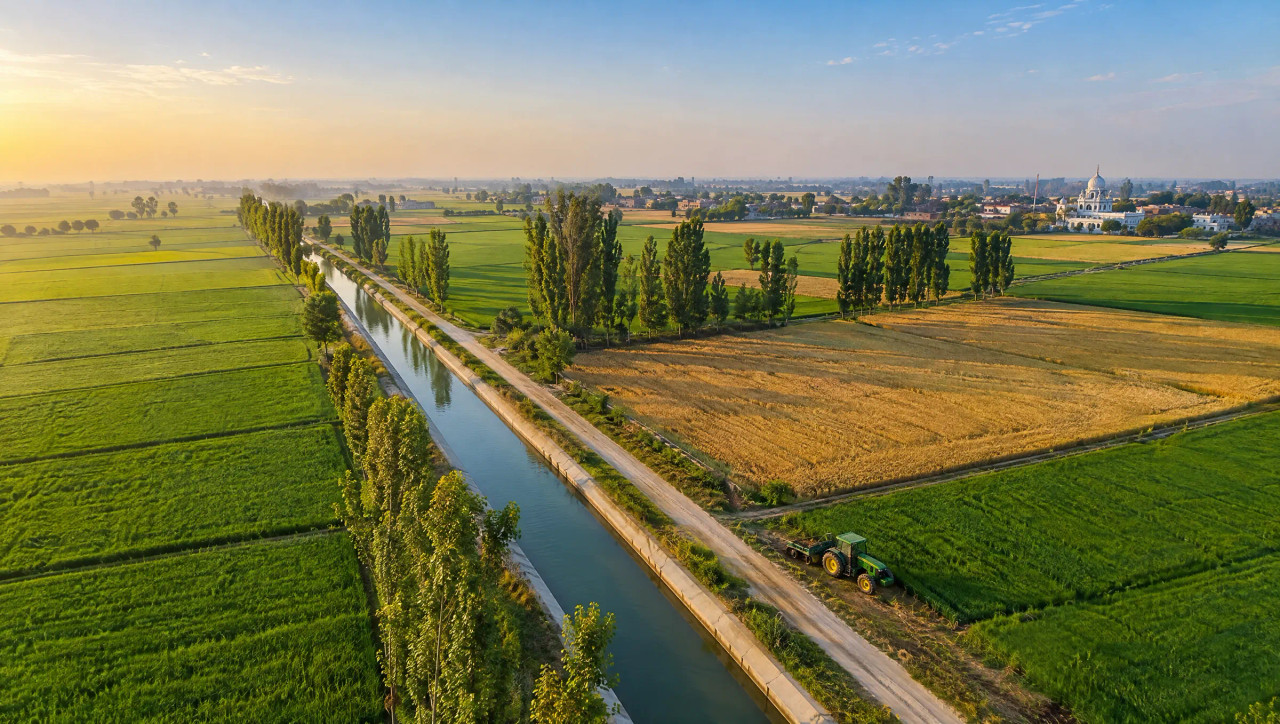
Punjab is the most agriculturally intensive of the six corridor states — ~83% net sown area, almost entirely under assured Green Revolution-era canal and tubewell irrigation. This is a genuine commodity-agriculture market, not a scarcity or speculative-appreciation one.
What sets Punjab apart from the rest of the corridor is its diaspora connection: a large, active share of buyers and sellers across Amritsar, Jalandhar, Ludhiana and Gurdaspur are NRIs or their families in Canada, the UK, and the US, transacting through Power of Attorney arrangements — a structural feature of the market that shapes how due diligence needs to work here specifically.
Major markets: Amritsar, Ludhiana, Jalandhar, Mohali, Patiala, the Chandigarh Tricity corridor, Bathinda and Gurdaspur.
- Wheat-Paddy Belt
- Amritsar
- Ludhiana
- Diaspora Market
- Chandigarh Tricity
- 23 Districts
Market bands
District price bands — Punjab
Collector rates were revised up to 145% in October 2024 — since stamp duty is calculated on the higher of collector rate or sale price, any estimate from before that revision is likely wrong.
| District | Zone / belt | Market band* (₹/acre) | Land type |
|---|---|---|---|
| Mohali | Chandigarh Tricity periphery | ₹1–3 Cr | Agricultural / peri-urban |
| Ludhiana | Industrial-agricultural belt | ₹40–90L | Agricultural |
| Amritsar | Border belt, wheat-paddy | ₹35–75L | Agricultural |
| Jalandhar | Doaba diaspora belt | ₹35–70L | Agricultural |
| Bathinda | Malwa cotton-wheat belt | ₹20–45L | Agricultural |
*Indicative bands; stamp duty, SSF and registration additional. Verify the current collector rate on PLRS before pricing an offer. Past movement is historical, not a projection.
Transaction costs
Stamp duty & registration in Punjab
7%
Stamp duty — male buyer
of market value or collector rate, whichever is higher
5%
Stamp duty — sole female
2% concession; 6% for joint male-female ownership
1% + 1%
SSF + Registration
Social Security Fund plus registration, capped at ₹2 lakh
Effective total is roughly 9% (male) or 7% (female) once the Social Security Fund cess is included. Collector rates were revised upward by up to 145% in October 2024 in some areas — confirm the current rate on PLRS before budgeting, since older estimates are likely stale.
Connectivity
How Punjab connects — road, rail, air and remote buyers
Punjab's buyer base is split between Delhi/NCR and Chandigarh, with a significant diaspora share transacting remotely from Canada, the UK and the US. Journey times vary with traffic and season.
🚗 By road from Delhi
✈️ By air
🚆 By rail
🌍 The remote-buyer reality
A meaningful share of Punjab land transactions happen entirely remotely, with the buyer never physically present in India — which is exactly why registered, sale-authorising Power of Attorney verification matters more here than anywhere else in the corridor.
Growth catalysts
Upcoming infrastructure & developments
Status labels maintained by the Farmland India research desk. Government-announced timelines — not guaranteed.
Mohali IT & Aerospace corridor
Continued IT-park and aerospace-park development around Mohali is the main driver of the state's highest land values, spilling into surrounding agricultural land.
Delhi–Amritsar–Katra Expressway
A high-speed corridor cutting travel time across the Doaba belt (Jalandhar, Amritsar) once complete — the single biggest connectivity catalyst for the state's northern districts.
October 2024 collector-rate revision
Not physical infrastructure, but the single biggest recent change to Punjab land-transaction economics — up to 145% higher in some areas, directly raising stamp duty on any transaction priced above the old rate.
Agriculture & terrain
Soil, crops & water across Punjab
Punjab is the most agriculturally productive state in the corridor — genuine Green Revolution infrastructure, not a scarcity-value thesis.
🌾 Majha & Doaba (Amritsar, Jalandhar)
Deep alluvial, canal- and tubewell-irrigated. Among India's highest wheat and paddy yields per hectare. Data: Soil Health Card portal.
- Wheat
- Paddy
🌱 Malwa (Ludhiana, Bathinda)
Cotton-wheat rotation in the southern belt, with Ludhiana's industrial base creating additional peri-urban land demand.
- Cotton
- Wheat
🏭 Tricity periphery (Mohali)
Agricultural value increasingly secondary to IT/aerospace-driven peri-urban demand — the state's highest per-acre pricing sits here.
- Peri-urban
🌾 Mandi price reference
Live wholesale mandi prices for wheat, paddy and cotton across Punjab's regulated markets — among the most active mandi networks in India — are published daily on Agmarknet.
💧 Water & rainfall
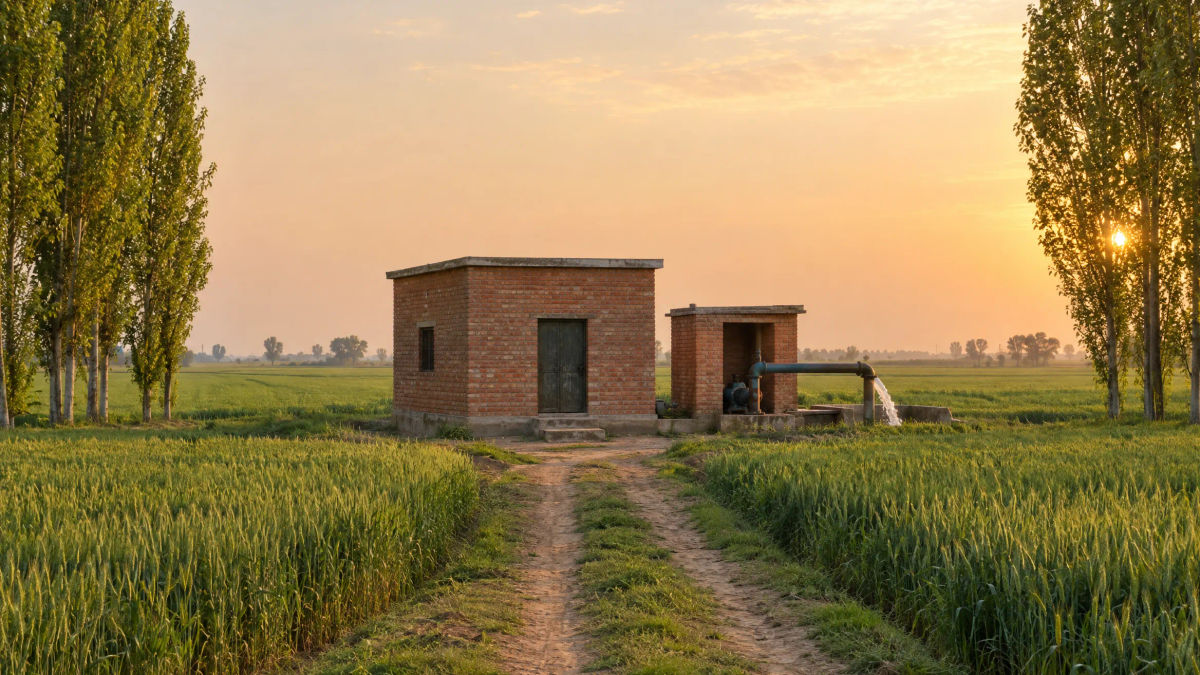
State average ~650 mm/year (IMD normals), but the real irrigation story is groundwater: decades of intensive paddy cultivation have left many Punjab blocks officially over-exploited by CGWB standards. Verify groundwater-block status and borewell depth directly for any parcel.
📐 Measurement units
Land in Punjab is transacted predominantly in Acres and Kanals (1 Acre = 8 Kanal), with Marla used for smaller parcels. Always confirm the unit stated on a listing before comparing prices.
At a glance
Mohali vs. the other major Punjab markets
| District | Price band* | Primary economy | Diaspora share |
|---|---|---|---|
| Mohali | ₹1–3 Cr/acre | IT / peri-urban | Moderate |
| Jalandhar | ₹35–70L/acre | Agricultural | High |
| Amritsar | ₹35–75L/acre | Agricultural | High |
*Same indicative-band caveat as the district price table above.
Farmland India view
Why investors look at Punjab
Three structural reasons this desk includes Punjab, with a note on why it's a smaller allocation than the rest of the corridor.
Genuine, assured-irrigation commodity income
Among the most productive per-acre wheat and paddy land in India.
A real diaspora buyer channel
Punjab's NRI-diaspora connection is structurally unique — a genuine, ongoing source of transaction demand.
Mohali/Tricity growth pocket
IT and aerospace-driven peri-urban demand gives one genuine appreciation pocket within an otherwise commodity-driven state.
Confirm Shamlat Deh status and Power of Attorney validity directly — these are not certified by Farmland India's review.
STRAIGHT TALK
Risks & challenges in Punjab
Read these before shortlisting — Punjab's specific risks (Shamlat Deh, PoA fraud) are different in kind from the rest of the corridor.
Shamlat Deh (village common land)
Village common land vested in the Gram Panchayat is not privately transferable, however convincing the paperwork looks. Cross-check every Khasra number on PLRS before any advance.
Power of Attorney fraud
A large share of NRI-linked sales route through a PoA holder. Verify the PoA is registered, current, and specifically authorises sale — not just property management.
Benami arrangements are a criminal offence
Buying in another person's name to circumvent any restriction carries 1–7 years' imprisonment and confiscation risk under the Benami Transactions Act. Never attempt a nominee workaround.
Groundwater depletion
Decades of intensive paddy cultivation have left many blocks officially over-exploited. Verify CGWB block status and borewell depth before assuming irrigation is sustainable.
Stale rate assumptions
Collector rates rose up to 145% in October 2024 — any pre-2024 cost estimate for stamp duty is unreliable. Always verify the current rate.
Fragmented joint holdings
Multi-generational joint khatas, common where family members have emigrated, complicate clean title. Insist on a current Jamabandi and clear mutation chain.
Who to contact
Local revenue & registration offices
Land classification queries, including Shamlat Deh status, route through the local Patwari and Tehsildar office. Sale-deed registration is handled by the local Sub-Registrar. Records are searchable directly on the Punjab Land Records Society (PLRS) portal.
KEEP EXPLORING
Districts & guides in Punjab
Districts
Guides & research
COMMON QUESTIONS
Frequently asked questions
Everything buyers, NRIs and investors ask before their first reviewed farmland purchase in Punjab.
Visit full wiki01 of 07
Can I buy agricultural land in Punjab?
Yes, any Indian citizen can, subject to the standard ceiling under the Punjab Land Reforms Act, 1972. No non-agriculturist bar applies.
02 of 07
What is Shamlat Deh and why does it matter?
Village common land vested in the Gram Panchayat, which cannot legally be sold to a private buyer. Always verify a parcel's Khasra number on PLRS before paying any advance — this is the most common source of Punjab land fraud.
03 of 07
What is the ceiling on agricultural land in Punjab?
18 standard acres of first-quality irrigated land per family, or up to 25 acres of unirrigated land, under the 1972 Land Reforms Act.
04 of 07
How do I verify a Power of Attorney seller?
Confirm the PoA is registered (not just notarised), currently valid, and specifically authorises sale rather than only property management, before relying on it.
05 of 07
What is the stamp duty on land in Punjab?
7% for male buyers, 5% for sole female buyers, plus a 1% Social Security Fund cess and 1% registration — an effective total of roughly 9% (male) or 7% (female).
06 of 07
ਪੰਜਾਬ ਵਿੱਚ ਸ਼ਾਮਲਾਟ ਦੇਹ ਜ਼ਮੀਨ ਕੀ ਹੈ?
ਸ਼ਾਮਲਾਟ ਦੇਹ ਪਿੰਡ ਦੀ ਸਾਂਝੀ ਜ਼ਮੀਨ ਹੈ ਜੋ ਗ੍ਰਾਮ ਪੰਚਾਇਤ ਦੇ ਅਧੀਨ ਹੁੰਦੀ ਹੈ ਅਤੇ ਨਿੱਜੀ ਤੌਰ 'ਤੇ ਵੇਚੀ ਨਹੀਂ ਜਾ ਸਕਦੀ। ਖਰੀਦਣ ਤੋਂ ਪਹਿਲਾਂ PLRS 'ਤੇ ਖਸਰਾ ਨੰਬਰ ਖੁਦ ਜਾਂਚ ਲਵੋ।
07 of 07
NRI ਪਾਵਰ ਆਫ ਅਟਾਰਨੀ ਰਾਹੀਂ ਵੇਚੀ ਜਾ ਰਹੀ ਜ਼ਮੀਨ ਕਿਵੇਂ ਜਾਂਚੀਏ?
ਇਹ ਯਕੀਨੀ ਬਣਾਓ ਕਿ ਪਾਵਰ ਆਫ ਅਟਾਰਨੀ ਰਜਿਸਟਰਡ ਹੈ, ਮੌਜੂਦਾ ਸਮੇਂ ਵੈਧ ਹੈ, ਅਤੇ ਖਾਸ ਤੌਰ 'ਤੇ ਵਿਕਰੀ ਦੀ ਇਜਾਜ਼ਤ ਦਿੰਦੀ ਹੈ।
Ready to look at what is available?
Browse reviewed listingsTransparency
Sources for this page
- Punjab Land Reforms Act, 1972 (Act No. 10 of 1973) — India Code
- Punjab Village Common Lands (Regulation) Act, 1961 — governing Shamlat Deh status
- Prohibition of Benami Property Transactions Act, 1988 (amended 2016)
- Stamp duty & registration — Indian Stamp Act 1899 (Punjab schedule), PLRS
- Collector rate revision (Oct 2024) — Punjab Revenue Department
- Soil data — Soil Health Card portal; Groundwater status — CGWB; Rainfall — IMD
- Mandi prices — Agmarknet, Directorate of Marketing & Inspection
- Administrative data — Census of India 2011
Data-currency note: Census figures reflect 2011, the most recent full Census. Collector rates change frequently — always verify directly. Report inaccuracies to wiki@farmlandindia.com.
For developers
Ready to explore Punjab farmland?
Browse reviewed projects and individual land parcels across Punjab — or if you own land here, list it with platform review and reach serious buyers.