.png)


.png)
Owner listed
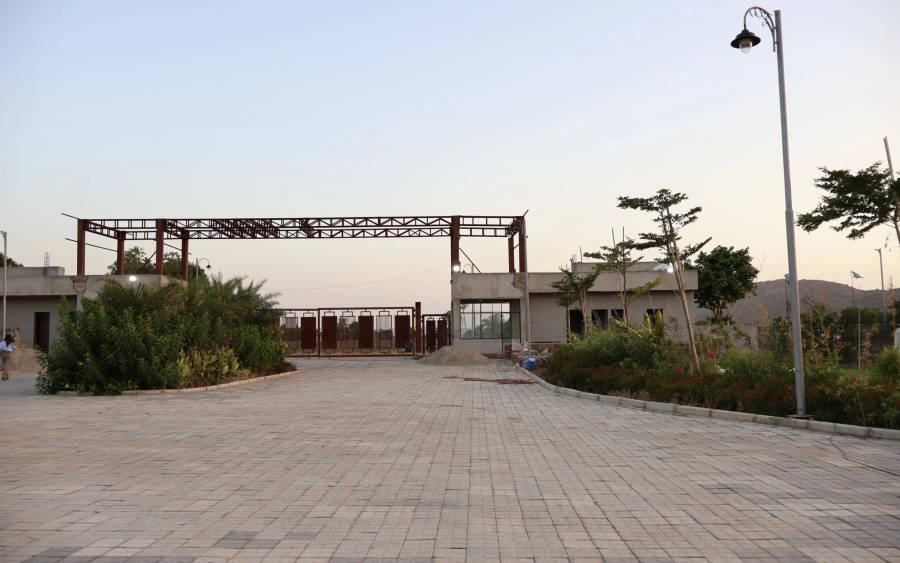
Ananda Agri Farm Tijara Alwar
Alwar, Rajasthan
Price on request15.00 acresView
State guide
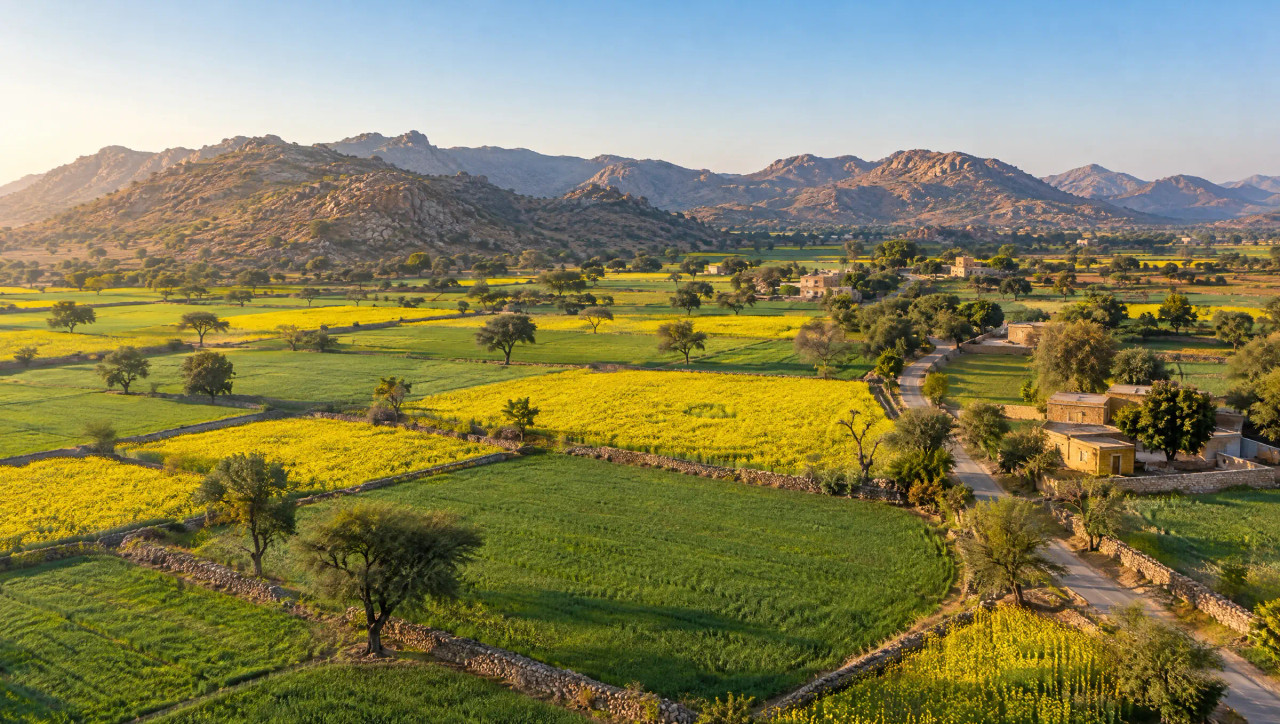
India's most open state for outside buyers — Aravalli farmland, the Delhi–Mumbai Expressway corridor, and a market that's welcomed non-agriculturist buyers since 2010.
50
Districts
~3,42,239 sq km
State Area
Apna Khata
Land Records
Open to Non-Agriculturists
Access
State land record — Rajasthan
Rev. 2026 · Farmland India desk
Divisions
7 (Jaipur · Jodhpur · Bikaner · Ajmer · Kota · Udaipur · Bharatpur)
Total districts
50 (post-2023 reorganisation)
State area
~3,42,239 sq km (largest state in India)
Net sown area
~48% of state area
Land records portal
Apna Khata (digitised)
Governing acts
Tenancy Act 1955 · Ceiling Act 1973 (amended 2010)
Stamp duty (agri land)
5% (M) / 4–5% (F) + 1% reg + 20% labour cess
✓ Rajasthan is the most open state in the Farmland India corridor for outside buyers. Since a 2010 amendment removed the non-agriculturist bar, any Indian citizen may buy agricultural land here — a rule most other North Indian states do not offer.
Who can buy agricultural land? Any Indian citizen — resident or non-resident of Rajasthan, agriculturist or not. This follows a 2010 amendment to the Rajasthan Imposition of Ceiling on Agricultural Holdings Act, 1973, which removed the earlier requirement that a buyer be a bona fide agriculturist. No domicile or residency test applies.
Ceiling limits still apply: a family may retain up to 18 acres of land with assured irrigation growing two crops a year, rising to 30 acres for single-crop irrigated land and up to 70 acres for unirrigated land, under Section 4 of the 1973 Act. Holdings above the applicable ceiling must be surrendered as surplus to the state.
SC/ST khatedar land — Section 42 of the Tenancy Act: land recorded to a Khatedar tenant belonging to a Scheduled Caste or Scheduled Tribe cannot be sold, gifted or bequeathed to a person outside that community. The Supreme Court (State of Rajasthan v. Aanjaney Organic Herbal Pvt. Ltd., 2012) confirmed this bar applies even to companies, and courts have repeatedly held that a purchase in breach of Section 42 is void from the start — possession, however long, does not cure it. Confirm the khatedar's community classification in the jamabandi before proceeding with any parcel.
Conversion for non-agricultural use — Section 90A: land bought for residential, commercial or farmhouse construction must be formally converted under Section 90A of the Rajasthan Land Revenue Act, 1956, which requires District Collector permission. Conversion must typically be applied for within a defined window of acquisition, with construction to commence within a set period after conversion is granted. Ask for the parcel's 90A/conversion status directly before assuming it is build-ready.
NRI & OCI buyers: FEMA 1999 prohibits NRIs and OCIs from acquiring agricultural land, plantation property or farmhouse land anywhere in India, Rajasthan included. NRIs may purchase a Section 90A-converted residential plot, subject to the same conversion rules above.
State overview
Rajasthan is India's largest state by area, spanning the Thar Desert in the west to the Aravalli hill range running diagonally through its centre. The Aravallis split the state agronomically: the north-east — Alwar, Bharatpur, Dausa, Jaipur — sits inside or adjacent to the National Capital Region and carries genuine irrigated farming and a fast-growing land-banking market; the desert districts to the west depend on the Indira Gandhi Canal and groundwater for any cultivation at all.
The state was reorganised in 2023, splitting several large districts into 50 (from the historic 33), including the creation of Khairthal-Tijara out of eastern Alwar. The Rajasthan Police portal and revenue department records reflect the new boundaries; older documents may still cite the pre-2023 district names.
For land buyers, the north-eastern corridor — Alwar, Dausa, Sawai Madhopur, Jaipur, Udaipur — is where genuine appreciation and farmhouse demand concentrates, driven by the Delhi–Mumbai Expressway and NCR proximity. Rajasthan's open buyer-eligibility rule (see Legal Rules above) makes it the easiest entry point in the corridor for a first-time land buyer.
Market bands
Bands are compiled from registered-transaction references and district DLC (District Level Committee) rate notifications. Every parcel varies with road frontage, khata type, water source and conversion status.
| District | Zone / belt | Market band* (₹/bigha) | Land type |
|---|---|---|---|
| Alwar | DME corridor / Bhiwadi belt | ₹8–30 lakh | Agricultural / farmhouse |
| Jaipur | NH-48 periphery | ₹15–45 lakh | Agricultural / peri-urban |
| Dausa | Lalsot belt, DME-adjacent | ₹6–18 lakh | Agricultural |
| Sawai Madhopur | Ranthambore periphery | ₹5–15 lakh | Agricultural / eco-tourism |
| Udaipur | Lake belt, resort corridor | ₹10–40 lakh | Resort / farmhouse |
*Indicative bands; stamp duty, registration, labour cess and 90A conversion charges additional. Cross-check current DLC rates for a specific parcel on the e-Panjiyan portal before pricing an offer. Past movement is historical, not a projection.
Transaction costs
5%
Stamp duty — male / joint
of market value or DLC rate, whichever is higher
4–5%
Stamp duty — sole female
4% for SC/ST/BPL women, 5% otherwise
1%
Registration fee
uniform, plus a 20% labour cess on the stamp duty amount
Effective total is approximately 7% (male) or 6% (female) of transaction value once the labour cess is included. Source: Indian Stamp Act 1899 (Rajasthan schedule), administered via the e-Panjiyan / Rajnivesh portal. Confirm current rates before budgeting, since concessions and cess components are revised periodically.
Connectivity
Rajasthan's corridor districts are a Delhi-NCR market first — the primary buyer base for Alwar, Dausa and Jaipur periphery genuinely originates in Delhi/Gurgaon. Journey times vary with season, traffic and road works; treat these as planning estimates, not guarantees.
Eastern Alwar sits directly on the Delhi–Mumbai Expressway, the single biggest driver of the district's land-banking demand. See the full route, current construction status and land-impact analysis in our Delhi–Mumbai Expressway wiki guide.
Growth catalysts
Status labels maintained by the Farmland India research desk. Government-announced timelines — not guaranteed.
The Barodameo–Pinan interchange serves eastern Alwar directly, compressing Delhi drive time and driving the district's land-banking demand.
Full corridor guide & alignment →A proposed regional rapid-rail extension would make Alwar rail-commutable from Delhi — a structural change if executed on the announced alignment.
At ~130 km, Jewar places eastern Alwar inside a two-airport catchment, with cargo and warehousing demand expected along the DME.
Jewar Airport land guide →The Parbati-Kalisindh-Chambal link lists eastern Rajasthan among beneficiary districts — a direct upgrade to irrigation reliability where groundwater stress is highest.
Agriculture & terrain
Soil and water access swing sharply between the Aravalli-fringe districts and the Thar Desert belt.
Sandy-loam with alluvial pockets in the east. Rabi mustard, kharif bajra, growing horticulture near assured-water pockets. Data: Soil Health Card portal, district reports.
Arid sandy soils, canal-dependent. Indira Gandhi Canal has converted large tracts to cotton and guar cultivation. Data: CGWB groundwater reports.
State average ~575 mm/year (IMD normals), ranging from ~250 mm in the desert west to ~900 mm in the southern hills. Groundwater is over-exploited in several Aravalli-fringe blocks — verify borewell yield per parcel.
Live wholesale mandi prices for mustard, bajra and wheat across Rajasthan's regulated markets are published daily on Agmarknet (Directorate of Marketing & Inspection, Ministry of Agriculture) — check the Alwar or Jaipur mandi for the corridor districts.
At a glance
| District | Price band* | Delhi distance | Access |
|---|---|---|---|
| Alwar | ₹8–30L/bigha | ~150 km | Open |
| Bharatpur | ₹6–20L/bigha | ~185 km | Open |
| Khairthal-Tijara | ₹10–35L/bigha | ~120 km | Open |
*Same indicative-band caveat as the district price table above.
Farmland India view
Four structural reasons this desk underwrites Rajasthan ahead of most of the corridor.
No non-agriculturist bar since 2010 — the lowest eligibility barrier of any Farmland India state.
Eastern Alwar's land market is still repricing around the expressway — the re-rating hasn't finished.
Mustard and onion give underlying productive value, not just a location bet.
Comparable expressway-adjacent farmland in Haryana trades meaningfully higher.
Buyers should independently confirm khatedar class and Section 90A conversion status — these are not certified by Farmland India's review.
STRAIGHT TALK
Read these before shortlisting — none of them are disqualifying, but each changes how you should structure a purchase.
Several Aravalli-fringe blocks are officially over-exploited. Verify CGWB block status and borewell yield before pricing in agricultural income.
Undivided family khatas and missing mutation entries are the most common review failure. Insist on a current jamabandi from Apna Khata and a clean mutation trail.
A parcel currently held by an SC/ST khatedar cannot legally transfer to a non-SC/ST buyer without government permission — verify khatedar class before any advance.
Registering near DLC value while paying market price is common practice but creates downstream capital-gains complications.
The 2023 split moved parts of Alwar into the new Khairthal-Tijara district — confirm which registry your parcel now sits in.
The RRTS extension and ERCP timelines are government-announced, not contractual. Price a parcel on today's fundamentals.
Who to contact
Mutation, 90A conversion applications and khatedari disputes route through the Sub-Divisional Magistrate (SDM) office of the relevant tehsil. Sale-deed registration is handled by the Sub-Registrar office under the e-Panjiyan system. District-wise office locations and jurisdiction maps are listed on the Rajasthan Revenue Department portal.
DEVELOPER PROJECTS · TRUST SCORE
Developer projects carry the platform Trust Score and a reviewed document set.
Alwar, Rajasthan
Dausa, Rajasthan
Dausa, Rajasthan
Alwar, Rajasthan
Alwar, Rajasthan
Alwar, Rajasthan
Reviewed projects have completed Farmland India's document and site review. Individual land parcels are listed by their owners and are not reviewed to the same standard. Always complete your own legal due diligence.
INDIVIDUAL LAND · LAND VERIFICATION SCORE
Individual listings carry the auto-calculated Land Verification Score (LVS).
Reviewed projects have completed Farmland India's document and site review. Individual land parcels are listed by their owners and are not reviewed to the same standard. Always complete your own legal due diligence.
KEEP EXPLORING
Districts
COMMON QUESTIONS
Everything buyers, NRIs and investors ask before their first reviewed farmland purchase in Rajasthan.
Visit full wiki01 of 07
Yes. Since a 2010 amendment to the Ceiling Act, any Indian citizen can buy agricultural land in Rajasthan regardless of occupation or residence — the most open rule in the Farmland India corridor.
02 of 07
A family may hold up to 18 acres of double-crop irrigated land, 30 acres of single-crop irrigated land, or 70 acres of unirrigated land, under the Rajasthan Ceiling Act, 1973.
03 of 07
Only if you are also from a Scheduled Caste or Scheduled Tribe. Section 42 of the Rajasthan Tenancy Act, 1955 makes any such sale to a non-SC/ST buyer void from the start — confirmed by the Supreme Court in 2012.
04 of 07
No. FEMA bars NRIs and OCIs from buying agricultural, plantation or farmhouse land anywhere in India, Rajasthan included. NRIs may buy a Section 90A-converted residential plot instead.
05 of 07
5% for male/joint buyers, 4–5% for sole female buyers, plus 1% registration and a 20% labour cess on the stamp duty amount — an effective total of roughly 6–7%.
06 of 07
हाँ, 2010 के संशोधन के बाद राजस्थान में कोई भी भारतीय नागरिक कृषि भूमि खरीद सकता है, चाहे वह किसान हो या न हो। यह पूरे फार्मलैंड इंडिया कॉरिडोर में सबसे खुला नियम है। हालांकि अनुसूचित जाति/जनजाति खातेदारों की भूमि पर धारा 42 के प्रतिबंध लागू होते हैं।
07 of 07
राजस्थान के Apna Khata पोर्टल (apnakhata.rajasthan.gov.in) पर जिला अलवर चुनकर जमाबंदी नकल, खसरा नंबर और खातेदार का नाम ऑनलाइन देखा जा सकता है। रजिस्ट्री से पहले ताज़ा जमाबंदी और म्यूटेशन एंट्री ज़रूर मिलान करें।
Ready to look at what is available?
Browse reviewed listingsTransparency
Data-currency note: Census figures reflect 2011, the most recent full Census — not current-year population. Report inaccuracies to wiki@farmlandindia.com.
For developers
Browse reviewed projects and individual land parcels across Rajasthan — or if you own land here, list it with platform review and reach serious buyers.
Farmland India ("the Platform"), operated by Bulk Procure Private Limited, is a digital marketplace for listing agricultural land, farmhouse and plotted development projects. The Platform is not a real estate broker, agent or intermediary under RERA or any other applicable law, and does not act for either party to a transaction.
Listings are submitted by developers, owners and their authorised representatives. Before publication, the Platform carries out a documentary review of the material supplied and records what was sighted. That review is limited to the documents made available to us at that time. It is not a title investigation, not a legal opinion, and not a warranty of title, approvals, or the accuracy of any information supplied by a lister. The Trust Score is an internal assessment produced from that review and is intended as a research aid, not as a guarantee of outcome.
Every buyer must carry out independent due diligence before any transaction — including verification of land records, encumbrance searches, approvals and regulatory compliance — through their own advocate and chartered accountant. Any legal or advisory professional introduced through the Platform is engaged directly by the user, on that professional's own terms; the Platform does not employ, supervise or accept responsibility for their work.
Nothing on the Platform is investment advice. Land values can fall as well as rise. The Platform is not liable for any loss, dispute or damage arising from a transaction between parties.