
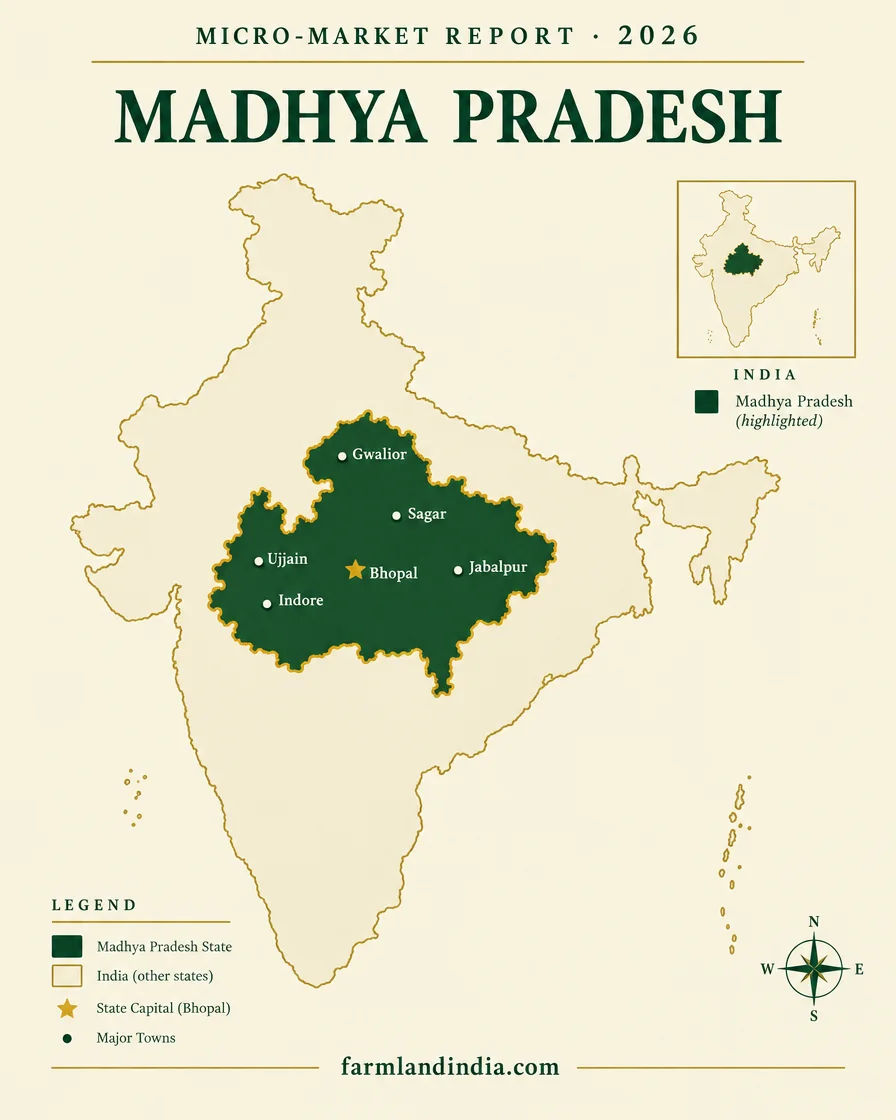
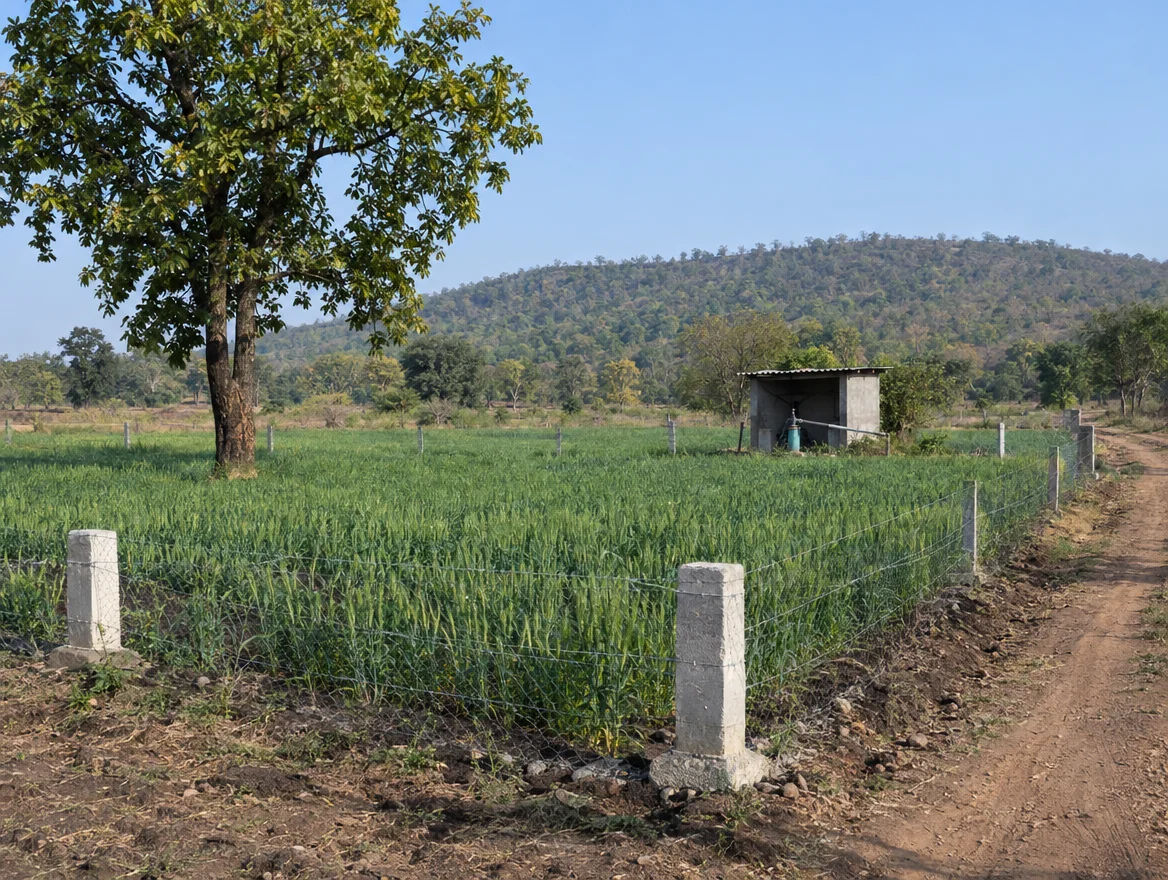

Owner listed
2.3 Hectare Agricultural Land with 180 m Main Road Frontage in Mundi, Khandwa, Madhya Pradesh
Chhalpi khurd, Khandwa, Madhya Pradesh
210000002.30 HectareView
State guide
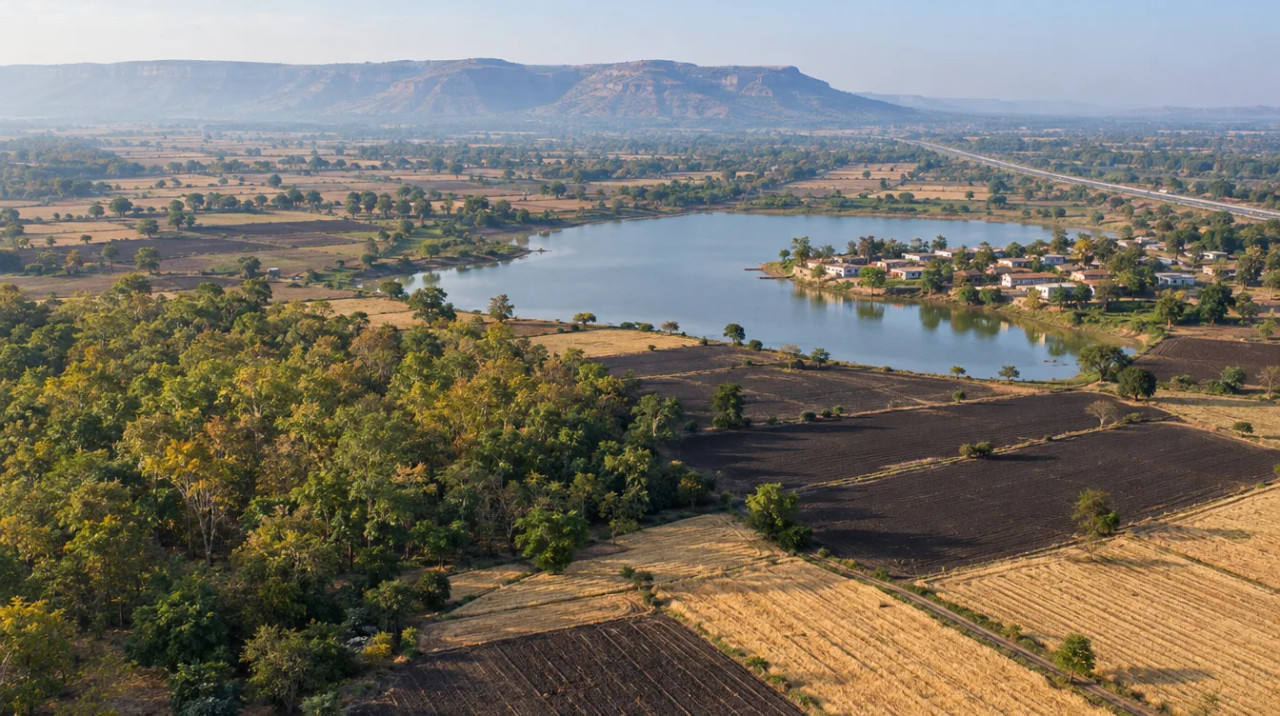
A 55-district state where tribal-land permission, a holding ceiling and a run of unfinished expressways decide what a parcel is worth.
55
Districts
3,08,245 sq km
Area
About 7.27 crore
Population (Census 2011)
10.5% (reported)
Sale-deed duty and fee
*Indicative range across districts and land types. Stamp duty, registration and conversion charges are additional. Local measurement units vary — every listing states the unit it is priced in. Not a valuation or an offer.
State land record — Madhya Pradesh
Rev. 2026 · Farmland India desk
Status
State of India, second largest by area (SLBC Madhya Pradesh state profile)
Districts
55 (SLBC Madhya Pradesh state profile); three added in 2023
Area
3,08,245 sq km (SLBC Madhya Pradesh state profile)
Population (Census 2011)
About 7.27 crore (SLBC Madhya Pradesh state profile)
Land administration
Revenue officers at Collector level (tribal land permissions) · Patwari and Tehsildar (village records) · Registration Department (sale deeds, Sampada 2.0)
Tribal land law
Section 165(6), MP Land Revenue Code, 1959 (Supreme Court, April 2025)
Stamp duty and fee (sale deed)
7.5% duty and 3% registration fee, as reported by Dainik Jagran English, March 2026; the Registration Department page was not opened
Guideline rates
2026-27 revision proposed for Bhopal (average 12%); final approval not confirmed (Dainik Jagran English, March 2026)
⚠ Madhya Pradesh does not run on a single rule for farmland. Tribal land, land above the holding ceiling, diverted land and ordinary farmland each follow a different track, and the Collector’s office sits at the centre of the first. Work out which track a parcel is on before looking at the price.
Which office decides what: A member of a tribe that the Code treats as aboriginal needs written permission from a revenue officer of at least Collector rank to sell land outside a notified area, and in a notified area the bar on sale to a non-tribal is absolute (section 165(6); Supreme Court, April 2025). The Supreme Court accepted in April 2025 that an Additional Collector can grant that permission under a valid work-allocation order (Lawyer E-News, April 2025). Sale deeds are registered through the Registration Department, which launched the Sampada 2.0 online registration system in October 2024 (The Statesman, October 2024).
Section 165 and tribal land: The April 2025 judgment concerned 6.29 hectares in Ratlam district outside the notified tehsils; the sale went through because the Additional Collector had given written permission, the price was above market value and a 10-year bar on changing the land’s use was attached under section 165(6-ee) (Supreme Court, April 2025). The High Court had earlier upheld the same sale and noted the Patwari’s report, the sellers’ need to fund a marriage and settle loans, and the land they kept (High Court, October 2023). Permission is a gate, not a formality: a sale with no permission is exposed. Under section 170B a transfer made by fraud can be reverted to the tribal owner or heirs, and the Supreme Court in March 2019 held that a civil court could not revisit a Collector’s 1985 section 170B order that had survived a writ petition (Supreme Court, March 2019).
Wills and indirect transfers: In February 2025 the High Court held that “transfer” in section 165(6) is not confined to sale and covers a Will of tribal land in favour of a non-tribal, so Collector permission was needed there too (High Court, February 2025). A buyer cannot assume that an inheritance document or a power of attorney avoids the permission step. There is a narrow carve-out: in October 2024 the High Court, relying on an older Division Bench ruling, held that sections 165(6) and 170 do not apply to Nazul land in an urban area, and sent the question of whether a given parcel was Nazul or Abadi back to the Additional Commissioner (High Court, October 2024).
Diversion and the Code: Turning farmland to another use is a diversion. A June 2022 High Court order refers to land “diverted under section 172” to non-agricultural purposes, and the Supreme Court has described section 59 as allowing reassessment of land revenue on a change of use, with a premium that the Sub-Divisional Officer may impose (High Court, June 2022; Supreme Court, August 2008). We could not read the current text of sections 172 and 190, so this page does not describe their procedure or fees, and a seller’s diversion order should be read in full, not taken on trust.
Ceiling on holdings: The Madhya Pradesh Ceiling on Agricultural Holdings Act, 1960 caps how much one holder or family may hold and provides for acquiring surplus land. In the 2021 case the Supreme Court quoted section 7(b) as allowing a family of five or fewer 54 acres, and set aside surplus declarations where a pending suit had not been disclosed (Supreme Court, January 2021). A legal-database copy of the Act lists three tiers for a family of five or fewer: 18 acres of two-crop irrigated land, 27 acres of one-crop irrigated land and 54 acres of dry land, and says land cannot be transferred before the final ceiling order without the Collector’s written permission, unless the holder is within the ceiling (legal database text of the 1960 Act). Treat those figures as the Act’s text as published there, and have a lawyer check the current schedule before buying a large holding.
Who may buy: None of the court orders or Act texts we opened bars a buyer simply for not being a farmer; the limits that turned up were the tribal-land permission in section 165(6) and the ceiling on holdings. We found no state notice listing other buyer conditions, so confirm with the Registration Department and the Collector’s office that none applies to the district you are looking at.
Registration and stamping: The Indian Stamp (Madhya Pradesh Second Amendment) Act, 2025 was published on 17 December 2025 and changes how short-stamped documents are handled, including a penalty of 1% of the deficient portion per month (TeamLease RegTech, December 2025). Duty rates are covered in the stamp duty section below.
Land records: Madhya Pradesh land records (khasra and the B-1 extract) are issued through the state’s MP Bhulekh portal. We could not open that portal for this page and found no independent description of its current fields or fees, so ask the seller for a fresh extract and compare the survey number, area and recorded owner with the sale deed.
NRI and OCI buyers: The Reserve Bank’s Master Direction under FEMA 1999 excludes agricultural land, plantation land and a farm house from what NRIs and OCIs may buy, in Madhya Pradesh as elsewhere (RBI Master Direction FED 12/2015-16, updated to September 2022). They can buy other immovable assets such as residential or commercial sites, and inheritance is treated separately in the Direction. Benami-law exposure was not checked against the Act text for this page, so take legal advice before using a nominee.
State overview
Madhya Pradesh is the second-largest state by area at 3,08,245 sq km and had about 7.27 crore people at the 2011 Census, according to the State Level Bankers Committee’s state profile, which lists 55 districts (SLBC Madhya Pradesh state profile). Three of those were created in 2023: Mauganj out of Rewa, Maihar out of Satna and Pandhurna out of Chhindwara (The Hitavada, September 2024; Drishti IAS, September 2024). Reports in 2024 named Nagda, Bina and Junnardeo as possible further districts (Zee News, January 2024; Zee News, August 2024), and we found no report that any has been created, so 55 is the number this page uses.
For a land buyer the state reads as four belts. The Malwa belt around Indore and Ujjain is driven by road and metro work and the 2028 Simhastha. The Bhopal side is tied to a proposed Bhopal–Indore expressway that is still at report stage. In the west, from Mandsaur through Ratlam to Jhabua, the Delhi–Mumbai Expressway runs through districts that also contain notified tribal tehsils. Along the Narmada, a planned expressway passes through 11 districts but has not been tendered.
This page is a rulebook and a signpost, not a listing of farm land for sale in Madhya Pradesh. The sourced material is strongest on tribal-land permission, the holding ceiling and the corridor projects, and thinnest on district-level prices, where we found no dated per-acre series. Expect the district pages to carry price evidence as it is sourced.
The four belts:
Malwa (Indore, Ujjain, Dewas): six-lane Indore–Ujjain road, a proposed ring road and the Indore Metro
Bhopal and Sehore: the proposed Bhopal–Indore expressway and a six-lane widening plan
West (Mandsaur, Ratlam, Jhabua): the Delhi–Mumbai Expressway section, with tribal-land rules in force nearby
Narmada belt: the planned Narmada Pragati Path, still in route planning
Sources: SLBC Madhya Pradesh state profile; The Hitavada, September 2024; Drishti IAS, September 2024; Zee News, January 2024; Zee News, August 2024
Market bands
Figures reflect real registered-transaction references from Bhopal and Indore localities; confirm against current DLC before shortlisting.
* Indicative market range compiled from listed inventory and public circle-rate references. Not a valuation, an offer, or a guarantee of transaction price. Verify current DLC / circle rates with the sub-registrar before transacting.
Price evidence
No dated asking-price series or official per-acre figure was sourced for Madhya Pradesh farmland. The rows below are guideline-rate reports: a valuation floor for duty, not a market price.
| Zone | Basis | Reference | Land type |
|---|---|---|---|
| Bhopal district | Guideline-rate proposal for 2026-27, as reported | Average 12% rise proposed across 740+ colonies and sent to the Central Valuation Board; approval not confirmed | Urban and peri-urban |
| Bhopal district (committee stage) | District valuation committee, February 2026, as reported | Rises recommended at 621 locations, with public suggestions invited on the Sampada 2.0 portal | Mixed, includes highway and ring-road locations |
| Madhya Pradesh (state) | Revision from 1 Apr 2023, as reported | Rates raised at about 18,000 locations; Bhopal about 2.9% | All land types |
| Indore district | Revision from 1 Apr 2023, as reported | Average rise of about 4.42%, 202 new locations added; bypass-area rises of up to about 60% | Urban and bypass belt |
| Agricultural land, per acre | Not sourced | We found no dated official per-acre guideline figure and no dated asking-price series | Farmland |
Sources: Dainik Jagran English, March 2026 (25 March), Free Press Journal, February 2026 (22 February), Free Press Journal, March 2023 and Free Press Journal, March 2023 (Indore). The 2026-27 figures are proposals as reported, and the reports do not say what the Central Valuation Board approved. A guideline rate is a floor used for duty, not a valuation or an asking price. The articles do not report rates for farmland, and a March 2026 Dainik Jagran English piece that quotes farm prices near ₹1 lakh an acre in a few districts could not be traced to an official series, so we have not used that figure (Dainik Jagran English, 27 March 2026). Past movement is not a forecast.
Transaction costs
7.5%
Stamp duty, reported
of market value or transaction value, whichever is higher; Dainik Jagran English, March 2026
~10.5%
Combined, reported
arithmetic of the two reported rates; an earlier piece put the range at 9.5% to 12.5% (Dainik Jagran English, March 2026)
Dainik Jagran English reported on 27 March 2026 stamp duty of 7.5% and a registration charge of 3% on the higher of market value or transaction value (Dainik Jagran English, March 2026). Its 25 March piece said a guideline-rate rise would raise duty and fees in proportion, and that the state had told the Vidhan Sabha no fresh taxes would be levied (Dainik Jagran English, March 2026). We could not open the Registration Department’s own fee page, so treat these as reported figures and ask the Sub-Registrar for the current schedule for agricultural land before you budget, since other levies or concessions may change the total. Since 17 December 2025 a short-stamped document attracts a penalty of 1% of the shortfall per month (TeamLease RegTech, December 2025). Registration can now be done online through Sampada 2.0, which also shows guideline rates by location (The Statesman, October 2024).
Connectivity
Road projects carry most of the story in Madhya Pradesh. Journey times are not sourced here and vary with traffic and works.
The Narmada Pragati Path was still in route and report planning in August 2026 (Free Press Journal, August 2026), the Bhopal–Indore expressway report was awaiting approval in September 2025 (India.com, September 2025), and the Indore Metro Super Corridor had not opened commercially by 22 June 2026 (Free Press Journal, June 2026). Price land on the road you can drive today.
Growth catalysts
Status labels reflect sources read in October 2026. Government-announced timelines are not guaranteed, and several items rest on one or two press reports.
01Open in part
Delhi–Mumbai Expressway section
05Planned, under way or delayed
Agriculture & terrain
Madhya Pradesh farmland is sold on permissions and corridors more than on crop stories, and the sourced crop and soil data here is thin.
Tribal-land rules decide which parcels can be sold at all. The April 2025 Supreme Court case involved Ratlam district land outside the notified tehsils, where permission was possible; inside a notified area the bar on sale to a non-tribal is absolute (Supreme Court, April 2025). The Delhi–Mumbai Expressway passes through Ratlam and Jhabua, so a corridor listing there needs the tribal-status check first.
Land around Indore, Ujjain, Dewas and Bhopal is where the road, ring-road and metro projects concentrate. We found no sourced crop mix or yield data for these districts, and no official per-acre rate. The survey number and recorded use in the revenue extract show how a parcel is classified.
The planned Narmada Pragati Path follows the river through 11 districts from Amarkantak towards the Gujarat border (Free Press Journal, August 2026). Alignment is under revision, so any parcel marketed as expressway-adjacent today is marketed on a proposal.
We did not source a crop pattern for Madhya Pradesh. Live mandi prices are on the Agmarknet portal for the nearest regulated markets, and the recorded use in the revenue extract shows what a parcel is classified as.
The Central Ground Water Board’s 2024 assessment puts the stage of groundwater extraction in Madhya Pradesh at 58.40%, which falls in its Safe range of 70% or less (CGWB, GWRA-2024). A state average hides block-level problems, so check the block category for any parcel that relies on a borewell.
Court orders in this state describe holdings by survey number and hectares (High Court, October 2023), while the Ceiling Act figures quoted above are in acres (Supreme Court, January 2021). One hectare is about 2.47 acres (our arithmetic). Confirm the unit on every listing before comparing prices.
At a glance
| Corridor | Main project | Land character | Source |
|---|---|---|---|
| Indore–Ujjain (Malwa) | Six-lane road upgrade; 48 km Hatod–Simhastha bypass at report stage | Peri-urban land pulled by the 2028 Simhastha and the Indore Metro | Free Press Journal, October 2024 |
| Bhopal–Sehore–Dewas | Bhopal–Indore expressway report awaiting approval; widening planned | Highway-belt land; guideline-rate rises proposed in Bhopal | India.com, September 2025 |
| Mandsaur–Ratlam–Jhabua | Delhi–Mumbai Expressway, 244 km MP section | Corridor land with notified tribal tehsils in the region | Swarajya, August 2023 |
| Narmada belt (11 districts) | Narmada Pragati Path, route being revised | Proposal-stage land; no tender yet | Free Press Journal, August 2026 |
Prices are not compared here because the evidence is not like for like: guideline rates are floors, listings are asking prices, and we hold no dated series for either at corridor level. Project status is as reported in the linked articles.
Farmland India view
Four reasons this desk looks at Madhya Pradesh, and the checks that go with them. Not a price forecast.
Four corridors have a named road or metro project with a dated report behind it, from the Indore–Ujjain six-lane upgrade (Free Press Journal, October 2024) to the Delhi–Mumbai Expressway section in the west (Swarajya, August 2023). Status differs by project, so read the status label before the headline.
The tribal-land track is long settled in court: Collector-level permission, a Patwari report and a use-change bar are all visible in the April 2025 judgment (Supreme Court, April 2025). A buyer who holds that paper trail is better placed than one relying on a seller’s assurance.
Guideline rates go through district valuation committees and a state board, and the Sampada 2.0 portal lets users look up rates by location (Free Press Journal, February 2026; The Statesman, October 2024). That gives a clearer cost floor than many rural markets, though it is not a market price.
The state-wide stage of groundwater extraction was 58.40% in the 2024 assessment (CGWB, GWRA-2024). That is a state figure; block-level checks still matter for any parcel.
Confirm tribal-land status, any ceiling-surplus proceedings and the diversion order directly; these are not certified by Farmland India’s review.
Read these before shortlisting. Madhya Pradesh’s risks are mostly about permission and records, and they stack.
A sale by a tribal landholder without the Collector-level written permission is exposed, and in notified areas it is barred outright (Supreme Court, April 2025). A Will in favour of a non-tribal needs the same permission (High Court, February 2025). A transfer made by fraud can be reverted under section 170B, even decades later (Supreme Court, March 2019).
The permission in the April 2025 case carried a 10-year bar on diverting the land under section 165(6-ee) (Supreme Court, April 2025). A listing that promises quick conversion of such land should be read against the permission order.
Change of use can bring reassessment and a premium (Supreme Court, August 2008). We could not read the current procedure under sections 172 and 190, so ask for the diversion order and the receipt for any premium.
Holdings above the ceiling can be declared surplus, and the 2021 Supreme Court case shows how long such disputes run (Supreme Court, January 2021). Before buying a large block, ask whether any ceiling proceedings were ever opened on the seller’s family.
We could not open the MP Bhulekh portal, so we cannot describe what its extracts show today. Compare a fresh khasra and B-1 extract against the sale deed, and be wary of any record that differs on area or owner.
The 7.5% stamp duty and 3% registration fee come from a press report, and an earlier piece gave a range of 9.5% to 12.5% (Dainik Jagran English, March 2026; Dainik Jagran English, March 2026). Ask for the current schedule before pricing.
Rates were revised at about 18,000 locations in 2023 (Free Press Journal, March 2023), and a 12% average rise was proposed for Bhopal in 2026 (Dainik Jagran English, March 2026). Budget duty on the schedule in force on the day of registration.
The Narmada road was first sought in 2018 and was still in route planning in August 2026 (Business Standard, February 2018; Free Press Journal, August 2026). The Indore Metro Super Corridor had missed six deadlines by June 2026 (Free Press Journal, June 2026). Price a parcel on today’s access.
Who to contact
Permission to sell land held by a member of an aboriginal tribe comes from a revenue officer of Collector rank or above, and the Supreme Court accepted in 2025 that an Additional Collector can act under a work-allocation order (Supreme Court, April 2025). The village Patwari reports on the land and the Tehsildar normally handles mutation, though we have not confirmed office names or fees for each district (High Court, October 2023). Sale deeds are registered with the Sub-Registrar under the Registration Department, now also through the Sampada 2.0 online system (The Statesman, October 2024). Guideline rates are set district by district by a valuation committee and approved at state level (Free Press Journal, February 2026). For the districts created in 2023 (Mauganj, Maihar, Pandhurna) ask which Sub-Registrar office now covers the village (Outlook India, June 2025).
INDIVIDUAL LAND · LAND VERIFICATION SCORE
Individual listings carry the auto-calculated Land Verification Score (LVS).
Reviewed projects have completed Farmland India's document and site review. Individual land parcels are listed by their owners and are not reviewed to the same standard. Always complete your own legal due diligence.
KEEP EXPLORING
Districts
COMMON QUESTIONS
Everything buyers, NRIs and investors ask before their first reviewed farmland purchase in Madhya Pradesh.
Visit full wiki01 of 04
None of the court orders or Act texts we opened bars a buyer for not being a farmer. The limits that appear are the Collector-level permission for land held by tribal members under section 165(6) of the Land Revenue Code and the holding ceiling under the 1960 Ceiling Act (Supreme Court, April 2025; Supreme Court, January 2021). Check the district rules with the Collector’s office.
02 of 04
Only with written permission from a revenue officer of Collector rank or above, and not at all by sale to a non-tribal inside a notified area. In April 2025 the Supreme Court upheld a Ratlam sale made with that permission, an above-market price and a 10-year bar on changing the land’s use. The High Court held in February 2025 that a Will needs the same permission.
03 of 04
Dainik Jagran English reported in March 2026 stamp duty of 7.5% and a registration charge of 3% on the higher of market value or transaction value, about 10.5% together. We could not open the Registration Department’s own page, so ask the Sub-Registrar for the current schedule. A short-stamped document attracts a 1% a month penalty on the shortfall since 17 December 2025.
04 of 04
No. The Reserve Bank’s Master Direction under FEMA 1999 excludes agricultural land, plantation land and a farm house from what NRIs and OCIs may buy, in this state as in the rest of India. They can buy residential or commercial sites, and inheritance is treated separately in the Direction.
Ready to look at what is available?
Browse reviewed listingsTransparency
Law and courts
Government
News
Further reading
Data-currency note: sources were read in October 2026. The MP Bhulekh portal, the Registration Department site and India Code could not be opened from our review environment, so nothing on this page is attributed to a reading of them. The Land Revenue Code, 1959 is cited through court orders, not its own text. Guideline rates, court orders and project timelines change often. Prices are guideline-rate reports, not valuations or asking prices. General information, not legal advice. Report inaccuracies to wiki@farmlandindia.com.
For developers
Browse reviewed projects and individual land parcels across Madhya Pradesh — or if you own land here, list it with platform review and reach serious buyers.
Farmland India ("the Platform"), operated by Bulk Procure Private Limited, is a digital marketplace for listing agricultural land, farmhouse and plotted development projects. The Platform is not a real estate broker, agent or intermediary under RERA or any other applicable law, and does not act for either party to a transaction.
Listings are submitted by developers, owners and their authorised representatives. Before publication, the Platform carries out a documentary review of the material supplied and records what was sighted. That review is limited to the documents made available to us at that time. It is not a title investigation, not a legal opinion, and not a warranty of title, approvals, or the accuracy of any information supplied by a lister. The Trust Score is an internal assessment produced from that review and is intended as a research aid, not as a guarantee of outcome.
Every buyer must carry out independent due diligence before any transaction — including verification of land records, encumbrance searches, approvals and regulatory compliance — through their own advocate and chartered accountant. Any legal or advisory professional introduced through the Platform is engaged directly by the user, on that professional's own terms; the Platform does not employ, supervise or accept responsibility for their work.
Nothing on the Platform is investment advice. Land values can fall as well as rise. The Platform is not liable for any loss, dispute or damage arising from a transaction between parties.