

Owner listed
Yog Anand Golf Living
Sindhudurg, Maharashtra
₹3591.00 AcreView
State guide
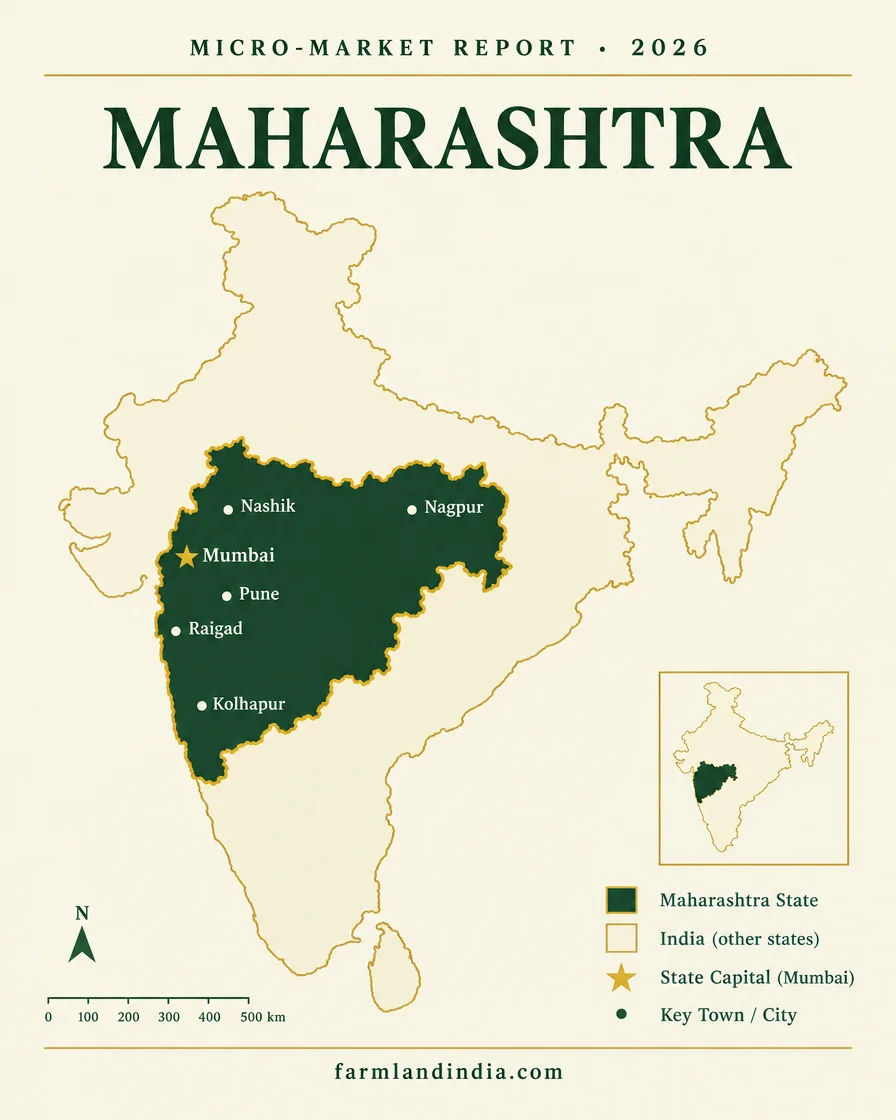
Only recognised farmers can buy agricultural land, the non-agricultural conversion rules were rewritten in December 2025, and the corridors that matter are the Samruddhi Mahamarg, the Pune Ring Road and the Navi Mumbai airport belt.
36
Districts
~308,000 sq km
Area
~112 million
Population (Census 2011)
Unchanged
Ready Reckoner 2026-27
State land record — Maharashtra
Rev. 2026 · Farmland India desk
Status
State of India · six revenue divisions
Districts
36 (Maharashtra SDMA)
Area
About 308,000 sq km with a 720 km coastline (Maharashtra SDMA)
Population (Census 2011)
About 112 million (Invest India)
Land administration
Collector and Tahsildar (permissions, mutation) · Settlement Commissioner and Director of Land Records (Elets, February 2025) · Inspector General of Registration (sale deeds, valuation)
Core agricultural law
Maharashtra Tenancy and Agricultural Lands Act, 1948 (Act 67 of 1948)
Stamp duty (sale deed)
5% plus a 1% levy in municipal areas and 4% in gram panchayat areas, per the Act text amended to May 2019 (Maharashtra Stamp Act, Article 25); current schedule not opened
Ready Reckoner rates
Unchanged for 2026-27, as reported by IANS, April 2026
⚠ Maharashtra reserves agricultural land for agriculturists. Section 63 of the Tenancy Act voids a sale to anyone else unless an exception or a Collector’s permission applies, and in July 2026 the Revenue Minister repeated that only recognised farmers may buy. Several other statutes then decide whether a parcel can be split, converted or built on. Read the 7/12 before you read the price.
Who may buy agricultural land: Section 63 of the Maharashtra Tenancy and Agricultural Lands Act makes a sale, gift, exchange or lease of agricultural land invalid in favour of a person who is not an agriculturist. It also bites where an agriculturist buyer would end up holding more than two-thirds of the ceiling area (Indian Kanoon text of section 63). The Collector, or an officer the State authorises, can permit a transaction on conditions, but not where the buyer would farm the land and has other income of Rs 12,000 a year or more, according to the same text. In Gundaji Satwaji Shinde v. Ramchandra Bhikaji Joshi (Supreme Court, December 1978) the Court held that whether a buyer is an agriculturist is for the Mamlatdar, not the civil court (Manupat case guide). On 8 July 2026 the Revenue Minister told the Assembly that only recognised farmers may buy agricultural land and that buyers must show proof of farmer status; IANS named no new statute (IANS, July 2026).
Where the bar does not apply: Maharashtra Act I of 2016 inserted sub-section (1C), which switches off the bar for land inside a Municipal Corporation, subject to conditions: non-agricultural use within a fixed time, with the Collector able to extend by up to five years (Acts of 2016 and 2018, PRS). Section 63-1A separately lets a buyer, farmer or not, take land for bona fide industrial use without prior Collector permission (Indian Kanoon text of section 63-1A). The Maharashtra Tenancy and Agricultural Lands Laws (Amendment) Act, 2026, effective 15 April 2026, narrows that route to occupancy class-I land, replaces the old non-agricultural assessment and nazarana with a one-time conversion premium under section 47 of the Land Revenue Code, and caps the penalty for late notice at five times that premium (JSA, June 2026). JSA describes no change to the general bar in section 63(1).
Tenant-purchased land and wills: Land a tenant bought under the Act cannot be sold, gifted, mortgaged or leased without the Collector’s prior sanction. After ten years the sanction falls away if the seller pays nazarana of forty times the assessment, the buyer is an agriculturist and the buyer stays within the ceiling (Indian Kanoon text of section 43). The 2026 amendment deletes the nazarana (JSA, June 2026). A will does not get round the bar: in Vinodchandra Sakarlal Kapadia v. State of Gujarat (15 June 2020) the Supreme Court read “assignment” in section 43 to include a bequest to a non-agriculturist (LiveLaw, June 2020; Supreme Court judgment). That appeal came from Gujarat, which applies the same 1948 statute, and the Court disapproved an earlier ruling under the separate Vidarbha Act. Marathwada and Vidarbha run on parallel Acts that the 2026 amendment also touches.
Fragmentation and minimum plot size: The Maharashtra Prevention of Fragmentation and Consolidation of Holdings Act, 1947 restricts sales of land below a notified standard area. A notification of 8 August 2023 set it, outside municipal corporation and council limits, at about a quarter acre for bagayat (irrigated) land and half an acre for jirayat (dry-crop) land, which is roughly 10 and 20 gunthas on our arithmetic of 40 gunthas to the acre (Cyril Amarchand Mangaldas via Conventus Law). The 2024 amendment moved the regularisation window to 15 October 2024 at a premium of up to 5%. A further Act notified on 31 December 2025, deemed in force from 3 November 2025, deletes the proviso to section 8B and adds section 9(4): past transfers and partitions from 15 November 1965 to 15 October 2024 are regularised without premium where the land is used for bona fide non-agricultural purposes inside listed urban, planning-authority, cantonment and regional-plan zones (TeamLease RegTech; Bill text, PRS). The bill did not change the standard area or the general restrictions. In July 2025 the Revenue Minister said plots up to one guntha subdivided before 1 January 2025 would be treated as legal, and a committee was set up the following week (The Week, July 2025; The Week, July 2025). Plain farm land outside those zones is still bound by the standard area.
Non-agricultural conversion: The Maharashtra Land Revenue Code (Second Amendment) Act, 2025, notified on 31 December 2025, substituted section 42. The Collector’s permission is no longer needed to use agricultural land for a purpose that a draft or final Development Plan or Regional Plan allows; the planning authority’s development permission or building plan approval is enough, and sections 42A to 42D, 44 to 46 and the old assessment chapter were deleted (JSA, March 2026). The yearly non-agricultural assessment gives way to a one-time premium under section 47 on the Ready Reckoner value: 0.1% up to 1,000 sq m, 0.25% from 1,000 to 4,000 sq m and 0.5% above 4,000 sq m. A government resolution of 10 February 2026 implements the change (Khaitan & Co, February 2026). Neither note says the reform alters section 63, so our reading is that a non-farmer still cannot buy agricultural land first and convert it afterwards.
Ceiling on holdings: The Maharashtra Agricultural Lands (Ceiling on Holdings) Act, 1961 caps what one family unit may hold, from 18 acres of assured-irrigation land to 54 acres of other dry-crop land in a 2011 summary (Bombay Chartered Accountant Journal, April 2011). Section 63 uses two-thirds of that ceiling as the test for a buyer who is already a farmer.
Tribal land: Where the seller belongs to a Scheduled Tribe, the sale also falls under the Land Revenue Code and the Restoration of Lands to Scheduled Tribes Act, 1974 (section 63-1A text). Ask for the seller’s status in writing.
Land records: Digitally signed 7/12 (record of rights), 8A (khata) and ferfar (mutation) extracts now carry legal validity under rules made under the Maharashtra Land Measurement and Record Keeping Act, 2025, with a QR code and a 16-digit verification number, no Talathi stamp and a fee of Rs 15 each (Free Press Journal, December 2025). About 2.57 crore signed 7/12 records existed by June 2024, and e-Mojani 2.0 handles measurement (Elets, February 2025). Read the occupancy class, the holder’s name and the land-use entry before paying a token.
NRI and OCI buyers: The Reserve Bank’s Master Direction lets NRIs and OCIs buy immovable assets in India but excludes agricultural land, plantation land and a farmhouse, and its inheritance paragraphs carry no such exclusion (RBI Master Direction FED 12/2015-16, updated to September 2022). A farmhouse plot is therefore out of reach by purchase, wherever it sits in Maharashtra. Anyone relying on a later circular should read it directly. We did not open the 2023 standard-area notification, the text of section 63A or the current ceiling schedule, so have an advocate check all three against the survey number.
State overview
Agricultural land in Maharashtra is plentiful but tightly gated. The state spans about 308,000 sq km with a 720 km coastline, has 36 districts in six revenue divisions, and splits into a wet Konkan and a rain-shadow interior in Marathwada and Vidarbha (Maharashtra SDMA). Roughly 112 million people live here, and about 45% are urban (Invest India). In January 2025 the Revenue Minister said the government had received no proposal for new districts and that a decision could follow the census (News On AIR, January 2025).
For a buyer the useful way to read the state is in layers. Agricultural-zone land can pass only to an agriculturist, with the exceptions covered above. Land inside municipal limits, planning-authority areas and regional-plan growth zones is where the fragmentation relief and the December 2025 non-agricultural reforms apply. Between them lies the corridor belt: the Mumbai–Nagpur Samruddhi Mahamarg is open, the Pune Ring Road is under construction, and the Shaktipeeth Expressway has only reached survey stage (The Week, June 2025; Bridge Chronicle, September 2026; Swarajya, June 2026). Scrutiny of out-of-state buyers has also risen, with Dhule and the Dodamarg area near Mopa airport named in the Assembly in July 2026 (IANS, July 2026).
This page is a rulebook and a signpost, not a listing of farm land for sale in Maharashtra. We do not publish asking prices for the state because no dated, sourced series was available to us.
Where to read next:
: parcels listed by Farmland India, with title documents shown where supplied
Project listings: farmland and farmhouse projects across the corridor
State-wise land laws: how Maharashtra compares with the other corridor states
Sources: Maharashtra SDMA; Invest India; News On AIR, January 2025; IANS, July 2026
Price evidence
No dated asking-price series was sourced for Maharashtra land. The rows below show how the Ready Reckoner moved by area type, as reported: a valuation floor for duty, not a market price.
| Zone | Basis | Reference | Land type |
|---|---|---|---|
| State average | Ready Reckoner revision, 1 Apr 2025, as reported | +3.89% | All area types |
| Rural areas | Same revision, as reported | +3.36% | Village land, including agricultural land |
| Municipal councils | Same revision, as reported | +4.97% | Council limits |
| Municipal corporations | Same revision, as reported | +5.95% | Corporation limits |
| Mumbai Municipal Corporation area | Same revision, as reported | +3.39% | Mumbai |
| All areas, 2026-27 | Status quo announced 31 Mar 2026, as reported | No increase on 2025-26 rates | All area types |
Sources: the 2025-26 increases are as reported by IANS, April 2026, with the state average and rural figure matched in Business Standard, April 2025; the 2026-27 freeze is reported by The Hitavada, April 2026 and The Realty Today, April 2026, which record that the Revenue Minister directed officials to hold rates and cite market turmoil and construction costs. Business Standard’s breakdown by municipal type differs slightly from IANS, so the IANS figures are used for those rows. Village-level rates are not reproduced here: the Inspector General of Registration’s notice board mentions a GIS-based valuation-zone project with no rate figures (IGR Maharashtra), and we could not open the rate lookup, so read the rate for your survey number from the department’s Ready Reckoner before budgeting. A Ready Reckoner rate is a floor for duty, not a valuation or an asking price.
Transaction costs
5% + 1%
Municipal corporation and council areas
of market value, with a further 1% levy from 8 Feb 2019 in notified areas; Act text to May 2019
The figures above come from a reproduction of Article 25 of the Maharashtra Stamp Act, 1958 amended to May 2019 (text), and the Rs 30,000 cap is repeated in a May 2025 report (Free Press Journal). The additional 1% for metro and infrastructure was still mentioned as current in April 2025 (Business Standard). The grantee bears the duty unless the parties agree otherwise, and an understated value draws the shortfall plus a penalty of 2% a month, capped at four times the deficit (Maharashtra Stamp Act PDF, IGR). The IGR home page and Citizen’s Charter we opened give no rate table (IGR Maharashtra; Citizen’s Charter), so the current schedule is unconfirmed and local rates can differ; read it from the department or the Sub-Registrar before budgeting. The May 2025 cabinet waived the registration fee on partition documents for agricultural land, not on sale deeds, and a May 2026 report of a further exemption on land purchases did not say which purchases it covers (Nation Press, May 2026).
Connectivity
The Samruddhi Mahamarg and the Navi Mumbai airport are operating, and the Mumbai–Pune link is open to light vehicles only. Journey times vary with traffic and works.
The Shaktipeeth Expressway has a final notification and joint surveys in 298 of 409 villages, but the report we read of 14 June 2026 had no compensation rates and no construction (Swarajya, June 2026). Price land on the road that exists today.
Growth catalysts
Status labels reflect sources read in October 2026. Government-announced timelines are not guaranteed, and several items rest on a single press report.
03Operating
Samruddhi, missing link, airport
04Under way or pending
Agriculture & terrain
Maharashtra is a large rain-fed state with small holdings, strong cotton, sugarcane and pulses belts, and a wet coast beside a dry interior.
The Sahyadri range holds the western edge, and the Konkan coast takes heavy south-west monsoon rain while Marathwada and Vidarbha sit in a rain shadow and often face drought-like conditions (Maharashtra SDMA). The 2025 monsoon was 109.1% of normal statewide, with 149 talukas in excess, 181 normal and 25 deficient (Economic Survey of Maharashtra 2025-26).
Net sown area was 16,571 thousand hectares in 2024-25 and gross cropped area 24,224 thousand hectares. Operational holdings number 171.11 lakh with an average size of 1.23 hectares in the provisional Agriculture Census 2021-22 (Economic Survey of Maharashtra 2025-26). Small holdings are why the fragmentation law matters so much.
Irrigation potential created up to 30 June 2024 was 57.16 lakh hectares, and 40.55 lakh hectares was used in 2024-25 on a provisional count. The survey no longer reports a gross irrigated share of cropped area after 2010-11 (Economic Survey of Maharashtra 2025-26). Check the irrigation source on the 7/12.
In 2024-25 cotton covered 4,123 thousand hectares, jowar 1,692 thousand and harvested sugarcane 1,167 thousand (Economic Survey of Maharashtra 2025-26). Invest India lists the state as the largest producer of gram, arhar and soybean and of grapes, and the second largest of sugarcane (Invest India). Crop mix varies sharply by district, so read the pattern for the taluka you are buying in.
The Central Ground Water Board’s December 2024 assessment puts the stage of extraction at 52.99%. Of 359 assessment units, 8 are over-exploited, 7 critical, 41 semi-critical and 302 safe (CGWB, December 2024). A safe state average can hide a stressed taluka, so look at the unit your parcel falls in.
Small plots are often quoted in gunthas. One guntha is about 1,089 sq ft (The Week, July 2025), and an acre of 43,560 sq ft therefore holds 40 gunthas (our arithmetic). Confirm the unit on every listing and on the 7/12 before comparing prices.
At a glance
| Act | Where it applies | Key land rule | Where to read |
|---|---|---|---|
| Maharashtra Tenancy and Agricultural Lands Act, 1948 | Most of the state outside Marathwada and Vidarbha (our reading) | Section 63 bar on non-agriculturists; section 43 sanction on tenant-purchased land | Section 63 text |
| Hyderabad Tenancy and Agricultural Lands Act, 1950 | Marathwada (our reading) | Section 47(3A) mirrors the five-year non-agricultural use rule | Amending Acts, PRS |
| Maharashtra Tenancy and Agricultural Lands (Vidarbha Region) Act, 1958 | Vidarbha | Parallel regime; a 2020 Supreme Court ruling disapproved an earlier Vidarbha-Act decision on wills | LiveLaw, June 2020 |
All three Acts were amended by the 2026 Laws (Amendment) Act to align them with the Land Revenue Code (JSA, June 2026). The regional mapping in the second column is our reading of the Acts’ names, not a quoted rule.
Farmland India view
Four reasons this desk looks at Maharashtra, and the checks that go with them. Not a price forecast.
The Samruddhi Mahamarg has run end to end since June 2025 (The Week, June 2025), Navi Mumbai’s airport has carried commercial flights since December 2025 (Gulf News, December 2025), and the Pune Ring Road is under construction (Bridge Chronicle, September 2026). Others are still on paper.
Because section 63 limits who can buy and the fragmentation law limits how small a parcel can be, land with clean title and a farmer buyer or a lawful exception is scarce. A buyer who can document both is better placed than one relying on a seller’s promise (section 63 text).
Digitally signed 7/12 and 8A extracts have legal validity and carry a verification number (Free Press Journal, December 2025), so title checks no longer depend on a Talathi’s stamp.
The Ready Reckoner rose 3.89% on average in 2025-26 and was held for 2026-27 (IANS, April 2026), which makes the duty base predictable for the year, though not a forecast of market prices.
Confirm farmer status, occupancy class and zone on the 7/12 directly; these are not certified by Farmland India’s review.
Read these before shortlisting. Maharashtra’s risks are mostly about who the buyer is and what the record says, and they stack.
A sale of agricultural land to someone who is not an agriculturist is invalid under section 63 unless an exception or permission applies (section 63 text). The Revenue Minister said in July 2026 that buyers must show proof of farmer status (IANS, July 2026).
Gifts are listed in section 63, and the Supreme Court has held that a bequest to a non-agriculturist falls foul of the Act too (LiveLaw, June 2020). Do not accept a family arrangement as a way round the bar.
Sales of fragments below the notified standard area are restricted, and such transactions could not be entered in the land records, which blocked later permissions (Bill 94 of 2025, PRS). The December 2025 relief covers listed urban and planning zones, not ordinary farm land. Ask which zone the survey number sits in.
Land bought by a tenant needs the Collector’s sanction to sell until ten years pass and conditions are met (section 43 text). The occupancy class on the 7/12 also matters: the 2026 amendment limits industrial purchases to class-I land (JSA, June 2026).
In the Dhule case raised in the Assembly, land extracts bearing a Tahsildar’s seal appeared forged and the police were told to register cases (IANS, July 2026). Check any extract against its 16-digit verification number on the state portal (Free Press Journal, December 2025).
The Shaktipeeth Expressway has a notification and surveys but no reported compensation rates (Swarajya, June 2026), and the Pune Ring Road’s western stretch slipped from a May 2026 target to December 2027 (Punekar News, December 2025; Bridge Chronicle, September 2026). Price a parcel on the access it has today.
The Fragmentation Act changed in December 2025, section 42 was rewritten the same month, a government resolution followed in February 2026, the tenancy laws changed in April 2026 and stricter farmer checks were announced in July (JSA, March 2026; JSA, June 2026). Rely on the current text, not a listing’s description.
The rates shown above come from an Act reproduction amended to May 2019, and a May 2026 report of an exemption on land purchases had no detail (Nation Press, May 2026). Ask for the current schedule before pricing.
Who to contact
Permissions under the Tenancy Act, tenant-land sanctions and conversion matters go to the Collector or an officer the State authorises (section 63 text), while questions on whether a buyer is an agriculturist go to the Mamlatdar (Manupat case guide). Extracts, mutation and the village record sit with the Village Revenue Officer or the Tahsildar’s office (Free Press Journal, December 2025), and the Settlement Commissioner and Director of Land Records runs the digital records and e-Mojani measurement (Elets, February 2025). Sale deeds are registered with the Sub-Registrar under the Inspector General of Registration, using the iSARITA system and online payment through GRAS (IGR Citizen’s Charter; IGR Maharashtra). Which Tahsil covers a given village depends on the survey number, so use the 7/12 to identify it.
DEVELOPER PROJECTS · TRUST SCORE
Developer projects carry the platform Trust Score and a reviewed document set.
Reviewed projects have completed Farmland India's document and site review. Individual land parcels are listed by their owners and are not reviewed to the same standard. Always complete your own legal due diligence.
KEEP EXPLORING
COMMON QUESTIONS
Everything buyers, NRIs and investors ask before their first reviewed farmland purchase in Maharashtra.
Visit full wiki01 of 04
Generally no. Section 63 of the Maharashtra Tenancy and Agricultural Lands Act makes a sale of agricultural land to a non-agriculturist invalid, apart from exceptions such as land inside a Municipal Corporation and purchases for industrial use, or a Collector’s permission (Indian Kanoon text, Supreme Court, December 1978). On 8 July 2026 the Revenue Minister told the Assembly that only recognised farmers may buy and that buyers must show proof of farmer status (IANS, July 2026). No new statute was named.
02 of 04
The Land Revenue Code (Second Amendment) Act, 2025, notified on 31 December 2025, replaced section 42: the Collector’s permission is not needed where a Development Plan or Regional Plan permits the use, and a one-time premium of 0.1%, 0.25% or 0.5% of the Ready Reckoner value by plot size replaces the yearly assessment (JSA, March 2026). A government resolution followed on 10 February 2026 (Khaitan & Co, February 2026). Neither note says the reform changes the farmer-only bar in section 63.
03 of 04
The Article 25 text of the Maharashtra Stamp Act amended to May 2019 gives 5% plus 1% in municipal corporation and council areas, with a further 1% levy from 8 February 2019 in notified areas, 4% in gram panchayat areas, and a registration fee of 1% capped at Rs 30,000 (Maharashtra Stamp Act, Article 25; Free Press Journal, May 2025). We could not open the current Inspector General of Registration schedule, so ask the Sub-Registrar for it before budgeting.
04 of 04
Not agricultural land, plantation land or a farmhouse. The Reserve Bank’s Master Direction under FEMA 1999 excludes them for NRIs and OCIs everywhere in India, while its inheritance paragraphs carry no such exclusion (RBI Master Direction FED 12/2015-16, updated to September 2022). Other immovable assets may be bought within FEMA rules.
Ready to look at what is available?
Browse reviewed listingsTransparency
Law and courts
Government
News
Further reading
Data-currency note: sources were read in October 2026. Several statute texts were read through Indian Kanoon, PRS and law-firm notes because the state portals did not open; the Mahabhumi portal, the IGR rate schedule and the 2023 standard-area notification were not read. Stamp duty rates rest on an Act reproduction amended to May 2019. Rules, rates and project timelines change often. Prices are Ready Reckoner movements, not valuations or asking prices. General information, not legal advice. Report inaccuracies to wiki@farmlandindia.com.
For developers
Browse reviewed projects and individual land parcels across Maharashtra — or if you own land here, list it with platform review and reach serious buyers.
Farmland India ("the Platform"), operated by Bulk Procure Private Limited, is a digital marketplace for listing agricultural land, farmhouse and plotted development projects. The Platform is not a real estate broker, agent or intermediary under RERA or any other applicable law, and does not act for either party to a transaction.
Listings are submitted by developers, owners and their authorised representatives. Before publication, the Platform carries out a documentary review of the material supplied and records what was sighted. That review is limited to the documents made available to us at that time. It is not a title investigation, not a legal opinion, and not a warranty of title, approvals, or the accuracy of any information supplied by a lister. The Trust Score is an internal assessment produced from that review and is intended as a research aid, not as a guarantee of outcome.
Every buyer must carry out independent due diligence before any transaction — including verification of land records, encumbrance searches, approvals and regulatory compliance — through their own advocate and chartered accountant. Any legal or advisory professional introduced through the Platform is engaged directly by the user, on that professional's own terms; the Platform does not employ, supervise or accept responsibility for their work.
Nothing on the Platform is investment advice. Land values can fall as well as rise. The Platform is not liable for any loss, dispute or damage arising from a transaction between parties.