

P03 Legal Framework & ComplianceAll India
The Laws That Govern Land Purchase in India
The Registration Act, Transfer of Property Act, stamp duty, RERA and state ceilings — the full legal stack behind an Indian land purchase.
Guide29 Oct 2026
Pillar
The central laws governing every land transaction in India - Transfer of Property, Registration and Stamp Acts, RERA, LARR and the Benami Act - set out in plain English.
All articles
Showing 1–8 of 12 articles
The Registration Act, Transfer of Property Act, stamp duty, RERA and state ceilings — the full legal stack behind an Indian land purchase.

Does RERA apply to your farmland project? Section 3's exemption, raw land vs plotted schemes, and how states read the rules differently.

A nil EC shows no registered entry was found; it does not prove clean title.

A gift deed moves land without payment and must be registered; here are the checks for donees and buyers.

A release deed lets a co-owner give up a share in land; it should be registered and every heir covered.

A power of attorney lets someone act for an owner but does not transfer land; learn the types and checks.

Four look-alike land record terms explained so a buyer can read records and spot mismatches.
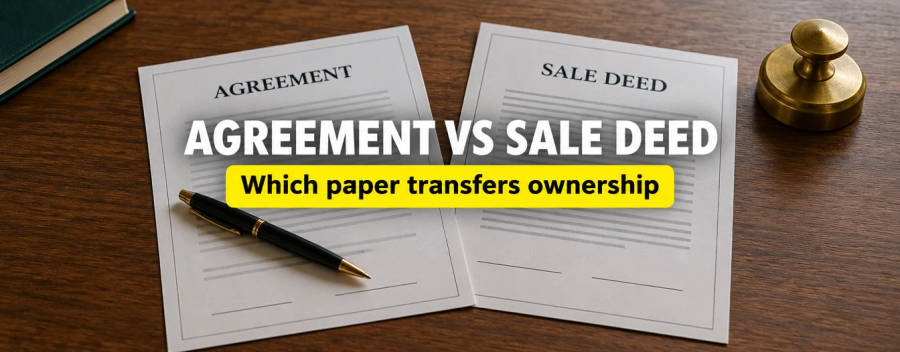
An agreement to sell is a promise; only a registered sale deed transfers land, and buyers must check title in between.
Related categories
All Pillar →Farmland India ("the Platform"), operated by Bulk Procure Private Limited, is a digital marketplace for listing agricultural land, farmhouse and plotted development projects. The Platform is not a real estate broker, agent or intermediary under RERA or any other applicable law, and does not act for either party to a transaction.
Listings are submitted by developers, owners and their authorised representatives. Before publication, the Platform carries out a documentary review of the material supplied and records what was sighted. That review is limited to the documents made available to us at that time. It is not a title investigation, not a legal opinion, and not a warranty of title, approvals, or the accuracy of any information supplied by a lister. The Trust Score is an internal assessment produced from that review and is intended as a research aid, not as a guarantee of outcome.
Every buyer must carry out independent due diligence before any transaction — including verification of land records, encumbrance searches, approvals and regulatory compliance — through their own advocate and chartered accountant. Any legal or advisory professional introduced through the Platform is engaged directly by the user, on that professional's own terms; the Platform does not employ, supervise or accept responsibility for their work.
Nothing on the Platform is investment advice. Land values can fall as well as rise. The Platform is not liable for any loss, dispute or damage arising from a transaction between parties.