How to Correct Errors in Online Land Records (2026)
How to get a wrong name, area or khasra number corrected: who to apply to, what evidence to attach, and which state rules we verified.
If the online record shows a wrong name, area or khasra number, the fix is made in the revenue register, not on the website. This guide sets out the route in Uttar Pradesh and Punjab where we verified it, and says plainly where we could not.
When can an online record be corrected, and when not?
Online land records are copies of the revenue department's registers. If the online view shows a wrong name, area or khasra number, the fix is almost never on the website itself. The correction must be made in the underlying record by a revenue officer, and the website then reflects it. This guide explains the route, state by state, only where we could verify the law on an official source.
Two kinds of problem look similar but are treated differently. A clerical error is a plain mistake in copying: a misspelt name, a wrong digit in an area, a wrong father's name. A dispute is a disagreement about who has the right: two people claim the same land, or a recorded owner is challenged. Revenue officers can correct the first kind. The second kind generally goes to a civil or revenue court. Section 38 of the Uttar Pradesh Revenue Code 2006, for example, says the power to correct errors does not include the power to decide a dispute involving a question of title.
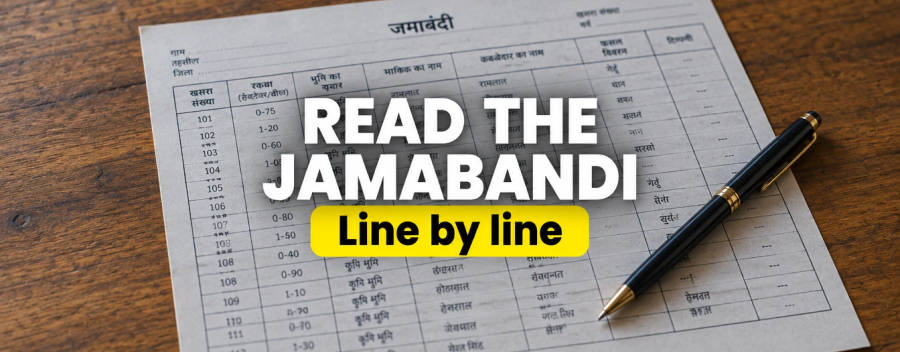
Before you apply, understand the entry. See how to read a jamabandi line by line and how to match a khasra number to a plot on the map.
Uttar Pradesh: correction of error and omission
The Uttar Pradesh Revenue Code 2006 is published on the Stamp and Registration Department's site. We opened it and read section 38, titled "Correction of error and omission". Our reading:
- Any person may apply to the Tahsildar to correct an error or omission in the map, the field book (khasra) or the record of rights (khatauni), in the manner prescribed. The Tahsildar can also act on an error that comes to his knowledge.
- The Tahsildar makes the inquiry he considers necessary and sends the case with his report to the Collector for corrections of the map, or to the Sub-Divisional Officer for other corrections.
- The Collector or the Sub-Divisional Officer decides after considering objections and evidence.
- Forged or manipulated entries in the map, khasra or khatauni may be expunged under the section.
- A Revenue Inspector may correct an undisputed error or omission in the khatauni or khasra after the prescribed inquiry.
- A person aggrieved by the order of the Collector or the Sub-Divisional Officer may appeal to the Commissioner within 30 days of the order, and the Commissioner's decision is final.
We could not confirm any deadline for the inquiry or the decision. The only period we found in the text is the 30-day appeal window. The prescribed form and procedure sit in the rules made under the Code, and we did not open those. For the UP records themselves, see Khasra Khatauni UP and UP Bhulekh land records.
Punjab: fard badar for clerical mistakes
The Punjab Department of Revenue publishes its Record of Rights chapter on its website. We read the sections available to us. Two points matter for corrections:
- Para 7.28 says clerical mistakes found after a jamabandi is attested are recorded in the fard badar and not through a fresh mutation. The revenue officer then orders the entry corrected or cancelled.
- Para 7.30 says that once an entry is in the jamabandi, a mutation should not be entered to correct it, except for a clerical error that a fard badar cannot fix or a patent fact. It adds that a person aggrieved by such an entry must seek a remedy by suit.
In plain terms, a simple copying error goes through the patwari and the fard badar, while a contested entry may need a court. The manual is a departmental document and parts of the online text were garbled, so confirm the current process with the tehsil. We could not confirm the section of the Punjab Land Revenue Act 1887 that governs each step, any fee, or any time limit. Related guides: Jamabandi Punjab, mutation status Punjab.
Rajasthan: what we verified
The Rajasthan Revenue Department publishes the Rajasthan Land Revenue Act 1956. The text available to us was truncated, so we verified only some provisions:
- Section 131 says the Land Records Officer maintains the map and field book and corrects any errors shown to have been made in them.
- Section 132 provides for the annual registers and the record of rights.
- Section 67 says a revenue court or officer that passed an order may correct, on its own motion or on a party's application, an error or omission that does not affect a material part of the case.
- Section 36 requires persons whose rights must be entered in an official register to furnish the information needed for correct compilation.
We could not read the Chapter VII sections that deal with corrections to record-of-rights entries, so we cannot state who decides, the time limits or the appeal route. Ask the tehsil. See the Apna Khata overview.
Haryana and other states
For Haryana, the district website for the Jamabandi portal describes the portal as a way to view sanctioned mutations and jamabandi records by owner name, khewat number or khasra number. It does not describe how to correct an error. We could not confirm the Haryana correction procedure, the governing section, any fee or any time limit from an official source. Ask the patwari and the tehsil, and see our Haryana jamabandi portal overview and mutation status in Haryana.
For states not covered here, we have not verified the law. Start with the patwari or the tehsil and ask which officer deals with correction of entries. Do not rely on a private agent's description of the law.
A practical sequence for any state
- Identify the exact error. Write what the record says and what it should say: name, father's name, area, khasra number, share.
- Classify it. Is it a clerical mistake, or does someone else claim the land? Seek advice if there is a dispute.
- Collect evidence. Typical supporting papers are the registered sale deed or other title document, the earlier jamabandi or khatauni copies, any mutation order, identity proof that matches the correct name and, for area errors, a map or measurement sketch. Which papers a given office will accept is for that office to say; we could not confirm a standard list.
- Ask the patwari what the office needs and in what form to apply. Ask for a receipt or diary number for anything you submit.
- Apply to the competent officer. In Uttar Pradesh that begins with the Tahsildar. In Punjab, clerical errors go through the patwari and the fard badar. For other states, ask the tehsil.
- Attend the hearing if notice is issued, and bring originals.
- Keep the order. After correction, ask for an updated copy of the record and compare with the online view.
- Appeal if refused, within the time allowed. In Uttar Pradesh, section 38 gives 30 days to appeal to the Commissioner.
Do not sign the sale deed over an open error
If the record is wrong, either have it corrected first or make the corrective step a written condition of the agreement. Paying first and fixing later leaves you holding the risk.
An illustrative example
The facts below are invented. They show how the route can look and are not a real case.
| Item | Illustrative facts |
|---|---|
| Entry | Online khatauni shows the owner as Ramesh Kumar, son of Mohan Lal; the registered deed says Ramesh Kumar, son of Mohan Lal Sharma |
| Type | Likely clerical, if no one else claims the land |
| Evidence | Registered deed, earlier khatauni copy, identity proof with full name |
| First step | Written application to the Tahsildar (Uttar Pradesh route) with copies and a receipt |
| If the area is wrong | Add a map extract or measurement; a map correction goes to the Collector in Uttar Pradesh |
| If a neighbour objects | The matter may become a dispute that the revenue officer cannot decide as a question of title |
What is unconfirmed
We could not confirm: the Haryana procedure and governing section; the Punjab section of the 1887 Act for each step and any fee or time limit; the Rajasthan provisions on correcting record-of-rights entries; the prescribed application form in any state; whether any state offers an online correction request; and the time any office takes. Do not treat this page as legal advice. For a disputed entry, consult a revenue lawyer in the district.