

District guide
Buying Land in Faridkot
Canal-fed Malwa farmland around a railway town: Punjab buying rules, seepage and canal-water risks, collector-rate news and no sourced per-acre price.
6.18 lakh
Population (Census 2011)
218 km (district portal)
Chandigarh by road
About 1,419 sq km
Area
Named among 12 districts with rises (Aug 2025)
Collector rates
*Indicative range across districts and land types. Stamp duty, registration and conversion charges are additional. Local measurement units vary — every listing states the unit it is priced in. Not a valuation or an offer.
PLRS — Punjab Land Records SocietyDistrict land record — Faridkot
Rev. 2026 · Farmland India desk
State
Punjab (Malwa region, south-west)
Sub-divisions
Blocks: Faridkot (99 villages) and Kotkapura (72) under the Faridkot and Jaitu tehsils (CGWB district booklet, 2013); later changes to the tehsil list not checked
Key markets
Faridkot city · Kotkapura · Jaitu
Agricultural land
Open to Indian citizens: the Land Reforms Act text sets a holding ceiling but no residence bar (PLRS text); NRIs and OCIs may not buy (RBI Master Direction)
Demand anchors
Canal-fed farmland · Ferozepur–Bathinda–Delhi rail line · Faridkot city services
Rail
Faridkot, Kotkapura and Jaitu have railway stations on the Ferozepur–Bathinda–Delhi line (Faridkot district portal)
Size and population
About 1,419 sq km · 6.18 lakh people at the 2011 Census (CGWB district booklet, 2013)
Pricing unit
₹ per acre for larger land
Local units
Revenue records give areas in acre, kanal and marla: 1 kanal = 20 marla and 8 kanal = 1 acre (standard Punjab usage; no official conversion table was opened). Take the area from the fard
Land records
Easy Jamabandi: jamabandi copies with a QR code and online mutation, launched June 2025 (The Tribune)
Land law is state law. These rules are maintained on the Punjab page and apply to every district within it.
Faridkot — land purchase legal rules
The Act text we read limits how much land a family may hold, not who may buy. The main check is land classification: village common land (Shamlat Deh) vests in the Gram Panchayat, and a private seller cannot pass title to it.
Who can buy agricultural land? Section 4 of the Punjab Land Reforms Act, 1972 (Act No. 10 of 1973) caps what a person or family may hold. We found no clause in the text we read that limits the buyer by domicile or occupation; the copy is a 2005 printout, so a Punjab revenue lawyer should confirm there is no later restriction.
Ceiling limits: under Section 4(2) the permissible area is 7 hectares of two-crop irrigated land, 11 hectares of one-crop irrigated land and 20.5 hectares of barani land, with other classes capped at 21.8 hectares. A family of more than five gets one-fifth extra per additional member, for at most three members. Section 12 makes a transfer beyond the limit void (Act text, Punjab Land Records Society). A 2017 amending Bill took land bought for housing, industry, tourism and institutions outside the Act and asks the buyer to tell the Collector of the change of use within a year (Punjab Vidhan Sabha, Bill 33-PLA-2017).
Shamlat Deh — the parcel that cannot be sold: under the Punjab Village Common Lands (Regulation) Act, 1961 this land vests in the Gram Panchayat, which may dispose of it only for the benefit of villagers and, under the rules, with prior government approval; the Collector decides disputes over its status. A private seller therefore cannot give a buyer title to it. Match every khasra number against the seller's current Jamabandi before paying any advance; the state reported in Tribune, June 2025 that its Easy Jamabandi portal issues free digitally signed copies with a QR code.
NRI Power of Attorney: a power-of-attorney sale does not transfer title; in Suraj Lamp & Industries v State of Haryana (Supreme Court, 2011) the Court held that only a registered deed of conveyance does, though an attorney may sign that registered deed for the owner. If the seller is abroad, read the PoA for an express power to sell and for its registration.
NRI & OCI buyers: the Reserve Bank's Master Direction under FEMA 1999 lets NRIs and OCIs buy immovable property other than agricultural land, plantation property or a farm house. That applies across India, Punjab included.
- Ceiling, not buyer class
- Ceiling: 7 / 11 / 20.5 ha
- Shamlat Deh: Panchayat land
- NRI PoA: registered deed
- NRI agri: barred (FEMA)
- Jamabandi check
Faridkot — district-specific notes
The full Punjab legal framework on our state page applies here in full. The notes below are specific to this district and are not repeated from the state page. Law was read in October 2026 from Act texts, one Supreme Court judgment and press reports; where an official page did not open, the note says so.
⚠ Any Indian citizen can buy, subject to a ceiling. The Punjab Land Reforms Act, 1972 (PLRS text) limits a holding under Section 4(2) to seven hectares of land irrigated for two crops a year, eleven hectares of one-crop irrigated land and 20.5 hectares of barani land, with 21.8 hectares as the outer limit for other and mixed classes, and Section 12 makes a transfer beyond that area null and void. The text we read carries no clause that bars buyers from outside Punjab or non-agriculturists; a Congress leader's January 2023 request for a Himachal-style law implies that none exists (The Tribune, January 2023). We read no amendments, so confirm any exemption with a Punjab revenue lawyer. See our ceiling guide.
⚠ NRIs and OCIs cannot buy agricultural land, plantation land or a farmhouse in India; the Reserve Bank's Master Direction under FEMA permits purchase of other immovable assets only (RBI Master Direction, updated September 2022). If you buy through a power of attorney, the Supreme Court held in Suraj Lamp & Industries v. State of Haryana (11 October 2011) that a sale through a general power of attorney does not pass title; only a registered conveyance does, though an attorney may sign a registered deed for the owner. See our NRI land guide.
⚠ Canal seepage and waterlogging are the district-specific land-quality issue. The Tribune reported in July 2018 that damaged lining on the Indira Gandhi canal and the Sirhind Feeder was letting about 1,800 cusecs seep out, waterlogging and salinising land in 11 Faridkot villages, with the water table reported to have risen from about 140 feet in 1960 to about three feet (The Tribune, July 2018). A Lok Sabha reply of 8 August 2024 said relining of the Rajasthan Feeder (RD 179000 to 496000), approved in September 2018 at ₹1,305.27 crore with ₹620.41 crore as central grant, was likely to finish in June 2025 and would address waterlogging in Muktsar, Faridkot and Ferozepur (Lok Sabha, August 2024). We found no later completion report, so ask whether a parcel near a canal reach has a history of standing water or salt crust.
⚠ Canal-borne pollution is a second issue. In April 2025 The Tribune reported that contaminated water from the Harike barrage entered the Sirhind Feeder Canal, hitting Ferozepur, Faridkot, Muktsar and Fazilka for about a month (The Tribune, April 2025). A parcel irrigated from the feeder should be tested for water quality.
⚠ Change of land use (CLU) is what makes farmland buildable, and colonies and plotted layouts fall under the Punjab Apartment and Property Regulation Act, 1995 (PAPRA). A notification of 5 December 2025 requires a colony promoter to hold the entire project land in clear title before CLU approval, replacing an earlier 25% threshold (Outlook Money, December 2025). Ask which development authority covers the village and which office issues the order. We opened no PUDA fee schedule, so we give no CLU fees or timelines. Read our CLU guide.
⚠ Plots cut from farmland are the main trap. A 2024 amendment to PAPRA, approved by the Assembly on 3 September 2024, let holders of a power of attorney or stamp-paper agreement to sell dated up to 31 July 2024 register plots of up to 500 sq yd in unauthorised colonies without a no-objection certificate (NOC) (The Tribune, October 2024); the window opened on 1 December 2024 and was extended to 31 August 2025 (The Tribune, March 2025). In March 2025 a High Court bench directed strict compliance with Section 20(3) (PTC News, March 2025), and The Tribune reported in May 2025 that the state had stopped registering plots in unauthorised colonies without an NOC (The Tribune, May 2025). We did not read the order, so ask the Sub-Registrar and a local advocate what the specific plot needs.
⚠ Land pooling: Punjab's Land Pooling Policy 2025 was notified in May or June 2025 (The Tribune's reports give 14 May and 4 June; the GMADA page dates it 4 June), amended on 25 July, stayed by the High Court on 7 August and withdrawn by notification on 14 August 2025; on 11 September the court disposed of the challenges as infructuous (The Tribune, September 2025). The Tribune reports an optional revised policy in November 2025 and an enhanced package in April 2026 (The Tribune, June 2026); we have not read the official text of either. Faridkot was not named in the reports we read, and we found no list of pooled villages for the district.
⚠ Border and reserved-land rules: Faridkot adjoins Ferozepur (district portal), which is a border district. In April 2026 the Ministry of Home Affairs asked the Deputy Commissioners of Ferozepur, Tarn Taran, Amritsar, Gurdaspur, Pathankot and Fazilka for a social impact survey on moving the border fence (All India Radio, 13 April 2026). Faridkot is not among those six, but check whether any part of a parcel falls inside the Ferozepur boundary or a restricted belt. We found no published rule that bars a buyer in a border district or adds a permission step, and we did not research BSF fence-zone rules. Shamlat Deh (village common land) is vested in the village panchayat by Section 4 of the Punjab Village Common Lands (Regulation) Act, 1961, so a private seller cannot give title to it. Forest and SC/ST-owned land also need a separate check anywhere.
Read the full Punjab land buying guide for buyer eligibility, stamp duty and NRI rules.
- Open to Indian citizens
- NRI/OCI barred (FEMA)
- Canal waterlogging
- Canal-water quality
- CLU before building
- Pooling policy status
District overview
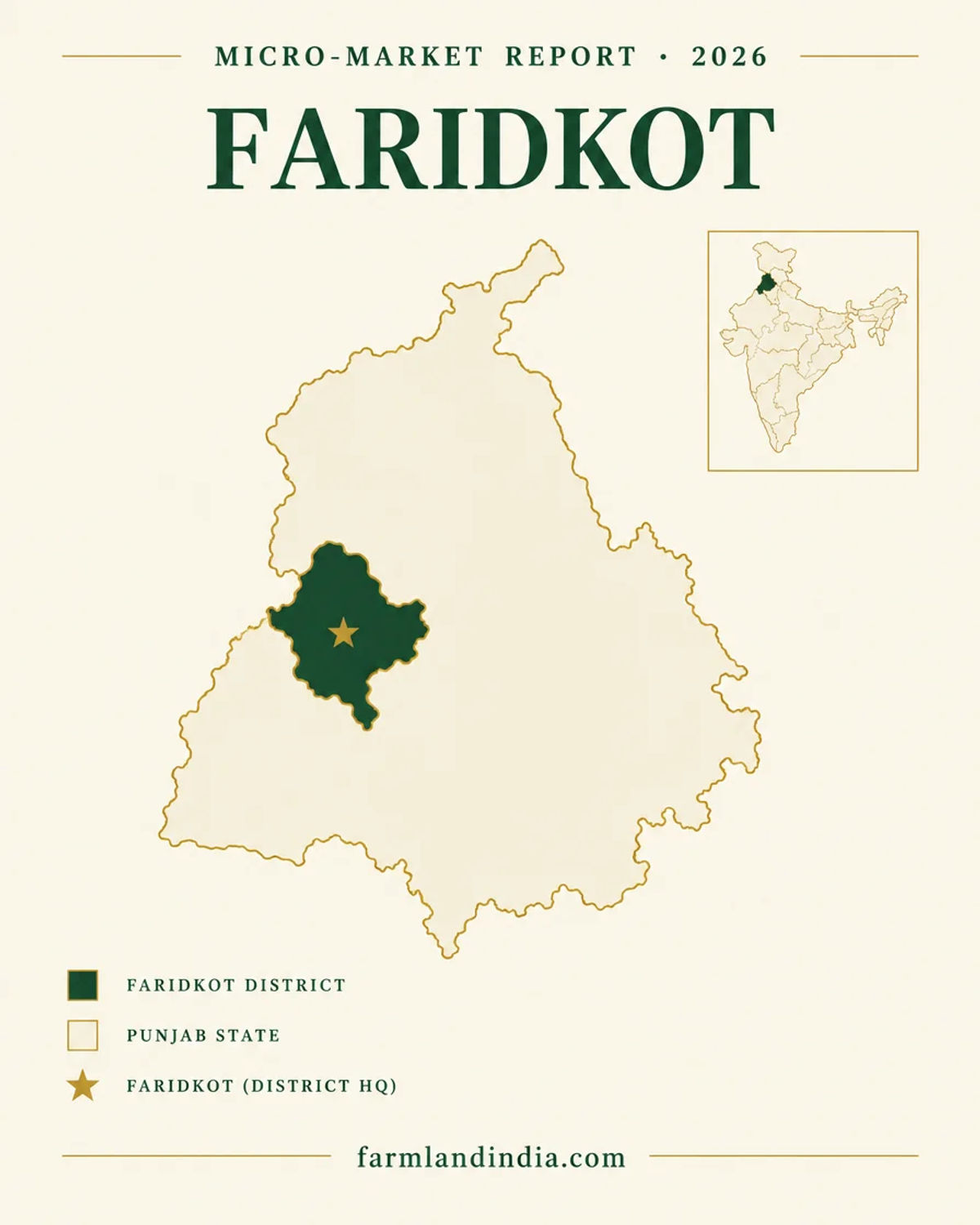
Faridkot — canal-fed Malwa farmland around a railway town
Agricultural land in Faridkot is canal-fed Malwa land in south-west Punjab, in one of the smaller districts of the state. CGWB's district booklet gives about 1,419 sq km, 6.18 lakh people at the 2011 Census, sandy loam as the major soil and a cropping intensity of 198% (CGWB). The district headquarters is 218 km from Chandigarh, 32 km from Ferozepur, 45 km from Muktsar and 65 km from Bathinda (Faridkot district portal).
Faridkot, Kotkapura and Jaitu have railway stations on the Ferozepur–Bathinda–Delhi line (district portal). The booklet lists paddy, American cotton and wheat as the main crops, with desi cotton and sugarcane also grown, and the Sirhind canal as the major irrigation source (data from the 2009-2013 period). The canal system is both the district's strength and its weakness: seepage waterlogged and salinised land in 11 villages in 2018, and polluted Harike water reached the Sirhind Feeder in April 2025.
We found no sourced per-acre price for Faridkot, so the price table carries none. Listing-site asking prices could not be traced to registered deals.
Collector rates matter here. The Tribune named Faridkot among 12 districts that had received rate rises of 5% to 50% by August 2025, without giving a Faridkot figure, and said the wider proposal was then put on hold after the land pooling backlash (The Tribune). That raises the registration cost for any deal valued below the new rate, so confirm the village rate in force before agreeing a price.
- Canal-fed land
- Sirhind Feeder
- Indira Gandhi canal
- Kotkapura
- Jaitu
- Railway town
- Collector rates raised
Transaction costs
Stamp duty & registration in Faridkot
5%
Stamp duty (2017-18 audit rate)
current rate to confirm with the Sub-Registrar
6% / 4%
Men / women, as reported
press reports, 2018 and 2020
1%
Registration fee
capped at ₹2 lakh (2017-18 audit)
The Comptroller and Auditor General's report on Punjab's revenue sector records stamp duty on a sale deed at 5% of the higher of the deed value and the collector rate, a 1% social infrastructure cess and a 1% registration fee capped at ₹2 lakh, as in force in 2017-18 (CAG report, 2019). The Tribune says an earlier 3% cess was waived in July 2017 (The Tribune, February 2020), and press reports of 2018 and 2020 put the rate at 6% for men and 4% for women (The Statesman, June 2018). A woman buying in her own name gets a 2% rebate on stamp duty, or 1% on a joint registration, and a 2018 amendment reclaims it if the land passes to a male relative within a year (same Statesman report). The state also waived 2.25% in extra duty and fees for March 2023 only (The Tribune, March 2023). We opened no official current rate schedule and found no report of a change in 2025 or 2026, so treat these as the last published figures and confirm the current rate with the Sub-Registrar before budgeting.
Collector rates matter as much as the duty rate. Faridkot is one of the 12 districts The Tribune named in August 2025 as having had rises of 5% to 50%, without a Faridkot figure; the wider proposal was then put on hold (The Tribune; first round 7 Aug 2024). We did not find the village-wise Faridkot list, so look up the village before pricing an offer. CLU fees, conversion charges and any affidavit or power-of-attorney costs are extra.
Know the belt
What is moving prices in Faridkot
Faridkot has no sourced price series and a clear canal story. Both are described below.
Farmland prices: none sourced
No per-acre figure sourced
We publish no Faridkot per-acre figure. Listing-site asking prices could not be traced to registered deals, and we found no village-level collector rate or compensation award.
Check: registered deeds from the same village and the village collector rate; there is no sourced band to anchor on.
Canal reaches: Indira Gandhi canal and Sirhind Feeder
No price found
The 2018 report found 11 villages waterlogged by canal seepage, including Machaki Mal Singh, Ratti Rori, Qilla Nau and Fidde Kalan (The Tribune). A parcel near a leaking canal can look cheap for a reason. The same canals also supply irrigation, so the question is condition, not presence.
Check: water-table depth, soil salinity and any history of standing water; ask neighbouring farmers.
Rail corridor: Faridkot, Kotkapura, Jaitu
No price found
The three towns have stations on the Ferozepur–Bathinda–Delhi line. The Tribune reported in July 2019 that the Centre had no plan to double the 87 km Bathinda–Ferozepur Cantt single line, which ran at 65% capacity, and that electrification sanctioned at ₹223.93 crore was expected to raise capacity (The Tribune, July 2019). That supports local trade, not farm values.
Check: the date and content of any railway announcement before treating it as a catalyst.
Circle rates
Named among 12 districts with rises (Aug 2025)
Faridkot is named among 12 districts with rises of 5% to 50%, with no district figure (The Tribune). The rate for your village could be well above an older sheet.
Check: the village agricultural rate on the day you sign the agreement.
Units: acre, kanal, marla
Punjab revenue records use kanal and marla: 1 kanal = 20 marla and 8 kanal = 1 acre (standard Punjab usage; no official conversion table was opened). Always ask for the area in the jamabandi and compare it with the area in the sale agreement. This page prices larger land per acre only.
Connectivity
How Faridkot connects — road, rail and air
Distances come from the Faridkot district portal; road times were not sourced and vary with traffic.
By road
By rail
By air
Rail and road links run through the three towns, but we found no sourced expressway in Faridkot. The Ludhiana–Bathinda highway runs through Ludhiana, Barnala and Bathinda districts (NBM&CW, October 2021); confirm the nearest access point before relying on it.
Growth catalysts
Upcoming infrastructure & developments
Status labels reflect sources read in October 2026. Government timelines are not guaranteed; items marked confirm rest on single, old or conflicting reports.
01Operational
02Planned or unconfirmed
Agriculture & terrain
Soil, crops & water in Faridkot
Paddy, cotton and wheat on canal-fed Malwa land, with seepage waterlogging in places and polluted canal water in 2025. Check the canal reach before the soil.
🌾 Canal-fed cropland
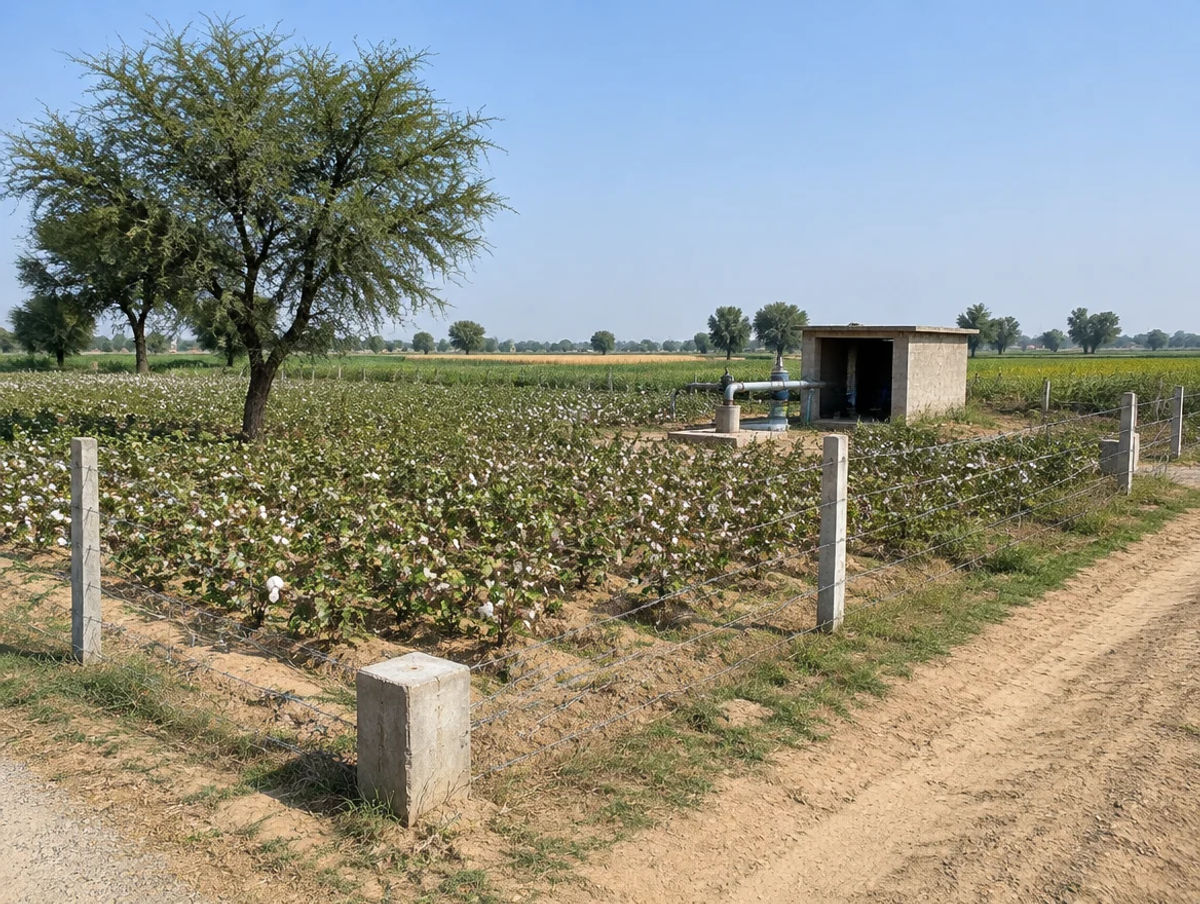
CGWB's district booklet lists paddy (kharif), American cotton and wheat (rabi) as the main crops, with desi cotton and sugarcane also grown, and reports that rice and sugarcane area has grown while cotton has declined (CGWB; 2009-2013 data). The Sirhind canal is the major irrigation source, with tubewells in fresh-water pockets, an irrigation intensity of 140% and a cropping intensity of 198%. Soils are mainly sandy loam, with sand dunes in the Hathar area.
- Paddy
- American cotton
- Wheat
- Sirhind canal
🧂 Waterlogging and salinity
In 2018 seepage from damaged canal lining waterlogged and salinised land in 11 Faridkot villages, with the water table reported at about three feet against about 140 feet in 1960 (The Tribune). CGWB's booklet puts about 3,000 hectares as alkaline or saline, mostly in Faridkot block (year not stated). Cheap land near a canal may be saline land, and salinity is hard to reverse.
- Seepage
- Salinity
- High water table
☣️ Canal-water quality
In April 2025 contaminated Harike water entered the Sirhind Feeder and reached Faridkot among other districts for about a month; the report says farmers feared stunted crops and reduced yields (The Tribune).
- Sirhind Feeder
- Harike
- Buddha Nullah
💧 Groundwater
Statewide, CGWB's 2024 assessment gives a stage of extraction of 156.87% with 115 of 153 assessment units over-exploited (CGWB), and PIB reports 156.36% for the 2025 assessment (PIB, December 2025). For Faridkot itself the latest figure we opened is the CGWB district booklet: 159%% at 31 March 2009 (up from 106%% in 2004), with both Faridkot and Kotkapura blocks over-exploited, and only 29%% of the groundwater suitable for domestic use. That is old data, so ask for the current block category. A high water table near canals is a different problem from deep falling tables elsewhere; ask which applies to the parcel.
📐 Measurement units
Convert every quote to acres before comparing offers: 1 kanal = 20 marla and 8 kanal = 1 acre (standard Punjab usage; no official conversion table was opened). Price a parcel on location, water and permitted use rather than crop income alone.
At a glance
Faridkot vs. its neighbours
| District / belt | Collector-rate news | Evidence |
|---|---|---|
| Faridkot — Puri Colony, Pakhi Road | Named among 12 districts with rises of 5–50%; no Faridkot figure | The Tribune, Aug 2025 |
| Bathinda | Up 5%; a further rise for some high-value areas awaiting approval | The Tribune, Aug 2025; see the Bathinda page |
| Mansa | Not named in the report | See the Mansa page |
| Moga | Named among the 12; no figure | See the Moga page |
| Ferozepur | Not named in the report | See the Ferozepur page |
Collector-rate news, not market prices; rates and proposals vary by locality. Faridkot has no sourced per-acre price. See the Bathinda page to the south, the Moga page to the east and the Ferozepur page to the north-west.
Farmland India view
Why investors look at Faridkot
Four reasoned points, with an honest note that price evidence is thin and canal condition is the swing factor.
A railway town with stable services
Faridkot, Kotkapura and Jaitu have stations on the Ferozepur–Bathinda–Delhi line, which supports trade and services. It is a stabiliser, not a growth catalyst.
Canal access is an asset when it works
A parcel on a healthy canal reach with a recorded water-course turn has dependable irrigation; one near a leaking reach may be waterlogged. The difference shows up in field inspection, not in a listing. Relining of the Rajasthan Feeder was meant to ease waterlogging, but we found no completion report.
Collector rates have moved
Faridkot is among 12 districts The Tribune reported with rises of 5% to 50% by August 2025, so some of the paper uplift may already have happened. A buyer should expect higher registration costs on a deal below the new rate.
No domicile bar
On the Act text we read, any Indian citizen may buy agricultural land in Punjab, so the buyer pool is wide. Title and water remain the deciding checks.
Confirm title, land class, water access and approvals directly; these are not certified by Farmland India’s review.
STRAIGHT TALK
Risks & challenges in Faridkot
Read these before shortlisting in Faridkot specifically.
Canal waterlogging and salinity
Seepage from damaged canal lining waterlogged 11 villages in 2018, and the relining meant to ease it had a stated completion of June 2025 that we could not confirm. Inspect for standing water, salt crust and a high water table, especially near the canal.
Polluted canal water
Harike water entered the Sirhind Feeder in April 2025. Test irrigation and drinking water before buying.
No sourced price series
We found no sourced per-acre price. Collect registered comparables from the same village before you negotiate.
Collector rates rose
Faridkot was among 12 districts with rises by August 2025, and a further statewide rise was put on hold. Registration cost can exceed older estimates.
Plots from farmland
The NOC position has swung since 2024: registration without an NOC was allowed for a window, the High Court directed strict compliance in March 2025 and the state halted such registrations in May 2025, as reported. A small plot without CLU and an approved layout may never be registrable on clean terms.
Ferozepur border proximity
Faridkot is not among the six districts named for the border-fence survey, but it adjoins Ferozepur, which is. Check the parcel against the district boundary and any restricted belt.
Over-exploited groundwater
CGWB's booklet put Faridkot at 159% extraction on 2009 data, with both blocks over-exploited, and only 29% of the groundwater was suitable for domestic use. Check borewell depth and test the water.
Who to contact
Local revenue, planning & water offices
Mutation (intkal) and revenue-record matters go to the Tehsildar of the tehsil (Faridkot, Jaitu or Kotkapura), and the Faridkot district portal lists the district. Easy Jamabandi gives digitally signed jamabandi copies with a QR code and handles online mutation (The Tribune, June 2025). Sale deeds are registered at the Sub-Registrar office; we did not open any Punjab rate or registration page.
Change of land use goes to the development authority covering the village; we did not open PUDA's pages, so confirm which office issues the order for yours. Canal, seepage and water-course questions go to the Water Resources Department canal division; tubewell and groundwater questions to the groundwater cell; water-quality questions to the Punjab Pollution Control Board.
KEEP EXPLORING
Explore more areas
Other districts in Punjab
Guides & research
- Kanal and Marla in Haryana and Punjab — Conversion GuideWiki · P01 Land Measurement Units
- Punjab Agricultural Land RulesWiki · P04 State-wise Land Laws
- Marla, Kanal and Killa in Punjab — What They MeanWiki · P01 Land Measurement Units
- Farmhouse Rules in Punjab (2026): Mohali and PAPRAWiki · P17 Farmhouse & Lifestyle Land
- Stamp Duty Calculator Punjab: Land Cost Method (2026)Wiki · P11 Taxation, Stamp Duty & Registration
- Bhu Naksha Punjab: Village Land Map Guide (2026)Wiki · P02 Land Records & Documentation
- Stamp Duty Punjab: Land Registry Charges (2026)Wiki · P11 Taxation, Stamp Duty & Registration
- Punjab CLU: Change of Land Use Explained (2026)Wiki · P06 Land Use, CLU & NA Conversion
COMMON QUESTIONS
Frequently asked questions
Everything buyers, NRIs and investors ask before their first reviewed farmland purchase in Faridkot.
Visit full wiki01 of 04
Can an outsider or NRI buy agricultural land in Faridkot?
Yes for Indian citizens, on the texts we read: the Punjab Land Reforms Act, 1972 sets a holding ceiling (Section 4(2): seven, eleven or 20.5 hectares by land class) but we found no residence bar. NRIs and OCIs cannot buy agricultural land under the RBI's FEMA Master Direction. A general power of attorney does not pass title (Supreme Court, 2011); only a registered deed does.
02 of 04
What does agricultural land cost in Faridkot?
We publish no per-acre band, because listing-site asking prices could not be traced to registered deals. The sourced item is collector-rate news: The Tribune named Faridkot among 12 districts with rises of 5% to 50% by August 2025, without a Faridkot figure.
03 of 04
Is canal-side land in Faridkot safe to buy?
Not automatically. The Tribune reported in 2018 that seepage from the Indira Gandhi canal and the Sirhind Feeder waterlogged and salinised land in 11 villages, and contaminated Harike water entered the feeder in April 2025. A Lok Sabha reply of August 2024 gave June 2025 as the likely completion of Rajasthan Feeder relining; we found no completion report. Inspect for standing water and test the water.
04 of 04
Have collector rates risen in Faridkot?
Yes, on the report we found: The Tribune named Faridkot among 12 districts that had received rises of 5% to 50% by August 2025, without a Faridkot figure, and said a further statewide rise was put on hold. Confirm the village rate in force with the Sub-Registrar before agreeing a price.
Transparency
Sources and references
Law and courts
- Punjab Land Reforms Act, 1972 (ss. 4, 12), Punjab Land Records Society, text opened October 2026
- Punjab Village Common Lands (Regulation) Act, 1961 (s. 4), India Code
- Suraj Lamp & Industries v. State of Haryana, Supreme Court, 11 Oct 2011
Government
- Master Direction FED 12/2015-16 on immovable assets under FEMA, Reserve Bank of India, updated 1 Sep 2022
- About Faridkot (distances, rail, neighbours), Faridkot district portal
- Faridkot ground water information booklet (area, population, crops, 2009 block table), CGWB
- Lok Sabha Unstarred Question 2875 on Rajasthan Feeder relining, 8 Aug 2024
- Dynamic ground water resources of Punjab 2024, CGWB
- Groundwater assessment, PIB, 18 Dec 2025
- Centre starts process to move border fencing in Punjab, All India Radio, 13 Apr 2026
- Land pooling policy page, GMADA
News
- Seepage from canals leaves 11 villages waterlogged, The Tribune, 30 Jul 2018
- Why Malwa is facing polluted water crisis, The Tribune, 29 Apr 2025
- No plan of doubling Bathinda-Ferozepur rail link, The Tribune, 18 Jul 2019
- MoRTH approves 18 projects worth 1,000 km in Punjab, NBM&CW, 14 Sep 2020
- NHAI expedites Rs 1,716-cr Ludhiana-Bathinda NH project, NBM&CW, 29 Oct 2021
- Bathinda-Delhi flight resumes, The Tribune, 9 Oct 2023
- Proposals to raise collector rates put on back burner, The Tribune, 13 Aug 2025
- Cash-strapped state hikes collector rates, The Tribune, 7-8 Aug 2024
- Stamp duty chapter, CAG report no. 3 of 2019 (Punjab revenue sector)
- Govt to impose 1% cess on property registration, The Tribune, Feb 2020
- Punjab amends rule to bar misuse of stamp-duty rebate for women, The Statesman, June 2018
- Punjab announces 2.25% exemption in stamp duty, The Tribune, Mar 2023
- Now NOC not needed to register land deeds, The Tribune, Oct 2024
- Now plots can be registered without NOC till August 31, The Tribune, Mar 2025
- HC halts plot registrations without mandatory NOC, PTC News, Mar 2025
- Govt stalls registration of plots without NOC, The Tribune, May 2025
- HC disposes of pleas against Punjab land pooling policy, The Tribune, Sep 2025
- Why Punjab keeps rewriting its land pooling policy, The Tribune explainer, Jun 2026
- Punjab tightens real estate rules: full land title mandatory for CLU, Outlook Money, Dec 2025
- Govt rolls out Easy Jamabandi portal, The Tribune, 13 Jun 2025
- Khaira seeks bill to restrict purchase of agri land by non-Punjabis, The Tribune, Jan 2023
Further reading
- Punjab Land Reforms (Amendment) Bill 2017, Punjab Vidhan Sabha
- Punjab Apartment and Property Regulation (Amendment) Bill 2024, PRS
- Village Common Lands Act page, Punjab Revenue Department
- Rajya Sabha reply on Punjab floods, MHA, 3 Dec 2025
- Balance-for-award list, NHAI, 1 Mar 2026
- Agriculture land-use statistics, Punjab Agriculture Department
- Monsoon 2026 report for Punjab, IMD Chandigarh
- Greenfield corridors under Bharatmala, PIB, 7 Feb 2024
Data-currency note: census figures reflect 2011, the latest full Census. The CGWB crop and groundwater figures are from a 2013 booklet with 2009 data, so they are dated. Rail and canal statuses are from 2018 to 2024 reports and may have changed. The stamp-duty figures are the last published ones we found; no official current rate schedule opened. Collector rates and policies change by notification. This is a general guide, not legal advice. Report inaccuracies to wiki@farmlandindia.com.
For developers
Ready to explore Faridkot farmland?
Browse reviewed projects and individual land parcels across Faridkot — or if you own land here, list it with platform review and reach serious buyers.