
District guide
Buying Land in Kapurthala
A small Doaba district on the Beas: open to Indian buyers on the text we read, with Phagwara's highway belt, flood-hit river villages and no sourced per-acre price series.
1,633 sq km
Area
8.18 lakh
Population (Census 2011)
5-50% (12 districts)
Collector-rate rise, Aug 2025
No bar found (NRIs barred)
Outsider agricultural land
*Indicative range across districts and land types. Stamp duty, registration and conversion charges are additional. Local measurement units vary — every listing states the unit it is priced in. Not a valuation or an offer.
PLRS — Punjab Land Records SocietyDistrict land record — Kapurthala
Rev. 2026 · Farmland India desk
State
Punjab
Sub-divisions
4 tehsils (Kapurthala · Sultanpur Lodhi · Bhulath · Phagwara) and 5 blocks (Kapurthala · Nadala · Sultanpur Lodhi · Dhilwan · Phagwara), per the district profile
Key markets
Phagwara · Kapurthala town · Sultanpur Lodhi · Bhulath · the Beas-side Mand villages
Agricultural land
The 1972 land-reforms Act caps holdings and we found no clause limiting who may buy; NRIs and OCIs may not buy agricultural land (RBI)
Demand anchors
Phagwara on the Grand Trunk Road · Phagwara–Hoshiarpur four-lane road (under way) · Delhi–Amritsar–Katra Expressway packages
Flood exposure
Beas-side villages in Sultanpur Lodhi flooded in August 2025
Rail
Not sourced for this page
Size and population
1,633 sq km · 8.18 lakh people (Census 2011 figure of 817,668 as given in the CGWB district plan)
Pricing unit
₹/acre
Local units
1 acre = 8 kanal · 1 kanal = 20 marla
Land records portal
Punjab Land Records Society (PLRS) · Jamabandi
Land law is state law. These rules are maintained on the Punjab page and apply to every district within it.
Kapurthala — land purchase legal rules
The Act text we read limits how much land a family may hold, not who may buy. The main check is land classification: village common land (Shamlat Deh) vests in the Gram Panchayat, and a private seller cannot pass title to it.
Who can buy agricultural land? Section 4 of the Punjab Land Reforms Act, 1972 (Act No. 10 of 1973) caps what a person or family may hold. We found no clause in the text we read that limits the buyer by domicile or occupation; the copy is a 2005 printout, so a Punjab revenue lawyer should confirm there is no later restriction.
Ceiling limits: under Section 4(2) the permissible area is 7 hectares of two-crop irrigated land, 11 hectares of one-crop irrigated land and 20.5 hectares of barani land, with other classes capped at 21.8 hectares. A family of more than five gets one-fifth extra per additional member, for at most three members. Section 12 makes a transfer beyond the limit void (Act text, Punjab Land Records Society). A 2017 amending Bill took land bought for housing, industry, tourism and institutions outside the Act and asks the buyer to tell the Collector of the change of use within a year (Punjab Vidhan Sabha, Bill 33-PLA-2017).
Shamlat Deh — the parcel that cannot be sold: under the Punjab Village Common Lands (Regulation) Act, 1961 this land vests in the Gram Panchayat, which may dispose of it only for the benefit of villagers and, under the rules, with prior government approval; the Collector decides disputes over its status. A private seller therefore cannot give a buyer title to it. Match every khasra number against the seller's current Jamabandi before paying any advance; the state reported in Tribune, June 2025 that its Easy Jamabandi portal issues free digitally signed copies with a QR code.
NRI Power of Attorney: a power-of-attorney sale does not transfer title; in Suraj Lamp & Industries v State of Haryana (Supreme Court, 2011) the Court held that only a registered deed of conveyance does, though an attorney may sign that registered deed for the owner. If the seller is abroad, read the PoA for an express power to sell and for its registration.
NRI & OCI buyers: the Reserve Bank's Master Direction under FEMA 1999 lets NRIs and OCIs buy immovable property other than agricultural land, plantation property or a farm house. That applies across India, Punjab included.
- Ceiling, not buyer class
- Ceiling: 7 / 11 / 20.5 ha
- Shamlat Deh: Panchayat land
- NRI PoA: registered deed
- NRI agri: barred (FEMA)
- Jamabandi check
Kapurthala — district-specific notes
The full Punjab legal framework on our state page applies to Kapurthala in full. The notes below are specific to this district. Each cites the Act text or the news report it rests on, and the Acts were read in the versions linked, not as amended to date.
⚠ Section 4 of the Punjab Land Reforms Act, 1972 caps what a person or family may hold. Under Section 4(2) the permissible area is 7 hectares of two-crop irrigated land, 11 hectares of one-crop irrigated land and 20.5 hectares of barani land, with an overall cap of 21.8 hectares for mixed land and an extra one-fifth per member above five, for at most three members. We found no clause in the text we read that limits who may buy; the copy is a 2005 printout, so a Punjab revenue lawyer should confirm there is no later restriction.
⚠ Village common land (Shamlat Deh) vests in the gram panchayat under the Punjab Village Common Lands (Regulation) Act, 1961, which may dispose of it only for the benefit of villagers and, under the rules, with prior government approval. A private seller therefore cannot give title to it. Match every khasra number against the seller's current jamabandi on the Punjab Land Records Society portal before paying any advance; the state reported that its Easy Jamabandi service issues free digitally signed copies with a QR code (The Tribune, June 2025).
⚠ Flood-plain land: the Beas runs along the district's western edge and the Sutlej along its southern edge (district profile). In August 2025 more than 20 villages near the Beas in Sultanpur Lodhi were affected and paddy was submerged across 22 villages of the Mand area (The Week/PTI, 16 August 2025); a bund at Aahli Kalan breached on 25 or 26 August and, according to Sant Balbir Singh Seechewal, flooded 35 villages and damaged paddy over 36,000 acres (The Tribune, 26 August 2025). The state ordered a special girdawari (crop-damage assessment) in the district (The Tribune) and a minister launched crop compensation at ₹20,000 per acre in October 2025 (The Tribune, October 2025). Ask a seller for flood history and check that the name on the current jamabandi is the seller's, because relief is assessed village by village on the revenue record.
⚠ NRIs and OCIs may buy immovable assets other than agricultural land, plantation land or a farm house under the Reserve Bank's Master Direction under FEMA, so this page is not a route for them to buy farmland. A seller abroad usually acts through a power of attorney; since Suraj Lamp & Industries v State of Haryana (Supreme Court, 2011), only a registered deed of conveyance moves title, so read the power for an express authority to sell and for its registration.
⚠ Plots in colonies fall under the 1995 Punjab Act that regulates colonies, plots and apartments (PAPRA). A 2024 amendment inserted Section 20(5), which allowed registration of plots up to 500 sq yd without a no-objection certificate where a power of attorney or agreement existed on or before 31 July 2024 (Bill 7-PLA-2024). The Tribune reported that the High Court struck the amendment down in April 2025, leaving the title of plots registered in the window uncertain (The Tribune, May 2025). We have not read the order, so ask the Sub-Registrar what is needed for the specific plot.
⚠ Land pooling: the Housing and Urban Development policy was notified on 4 June 2025 and amended on 25 July 2025, and GMADA's policy page shows no withdrawal notice (GMADA). The Tribune reports a withdrawal by notification dated 14 August 2025 and the High Court disposing of the challenges as infructuous on 11 September 2025 (The Tribune), then an optional revised policy in November 2025 and an enhanced package in April 2026 (The Tribune explainer). We have not read the official text of the later versions and found no village list for this district.
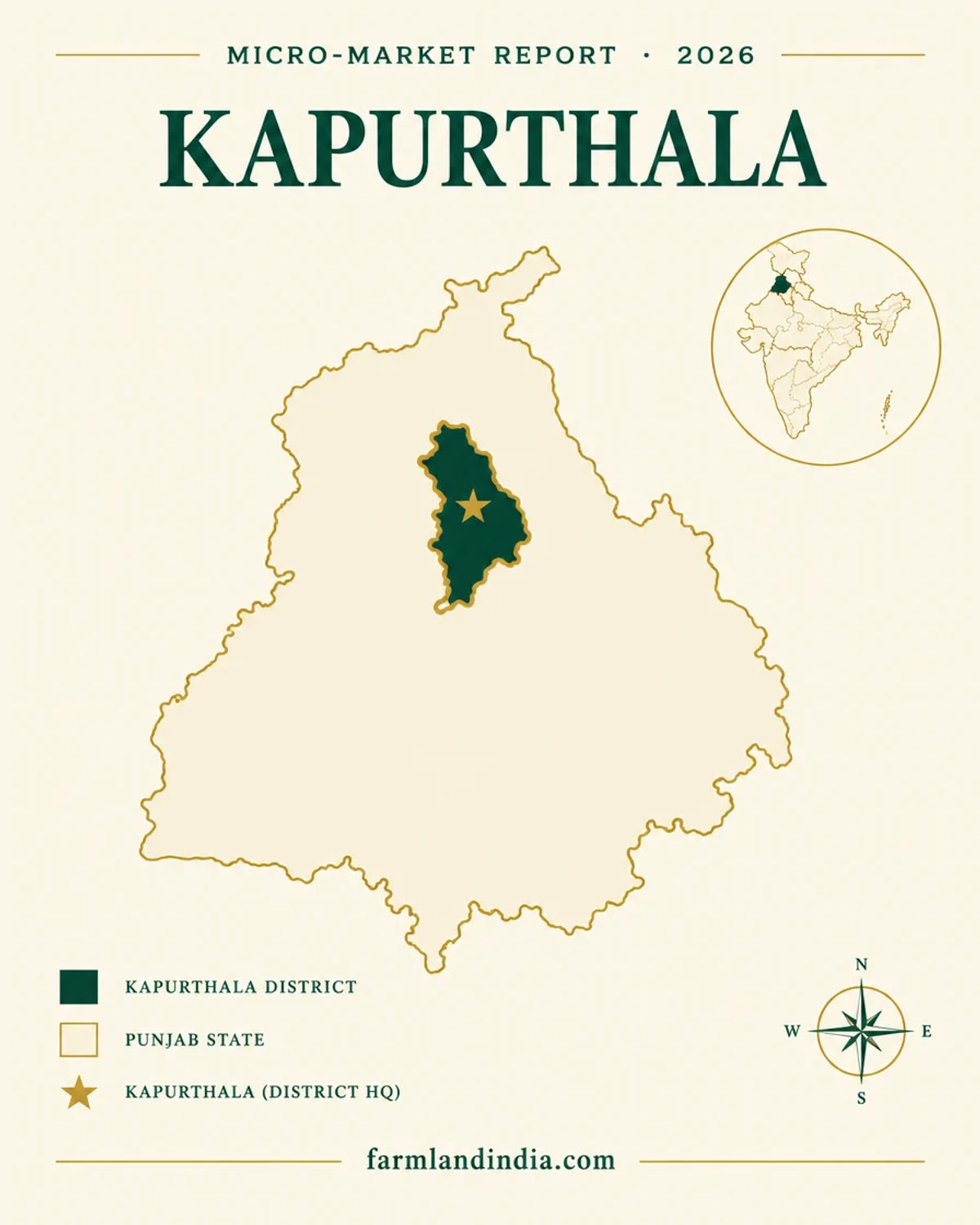
⚠ Phagwara sits on the Jalandhar road and is often listed with Jalandhar, but the Kapurthala district portal lists it as one of the district's four tehsils (district portal). If a listing says Phagwara, the revenue estate and the Sub-Registrar are Kapurthala's; confirm the district on the khasra before comparing rates or choosing a registration office.
Read the full Punjab land buying guide for buyer eligibility, stamp duty and NRI rules.
- No buyer-class clause found
- Holding ceiling
- Shamlat Deh
- Beas flood plain
- Colony NOC risk
- Phagwara is Kapurthala
- NRI agri bar (RBI)
District overview
Kapurthala — a small Doaba district where the Beas decides which land is safe
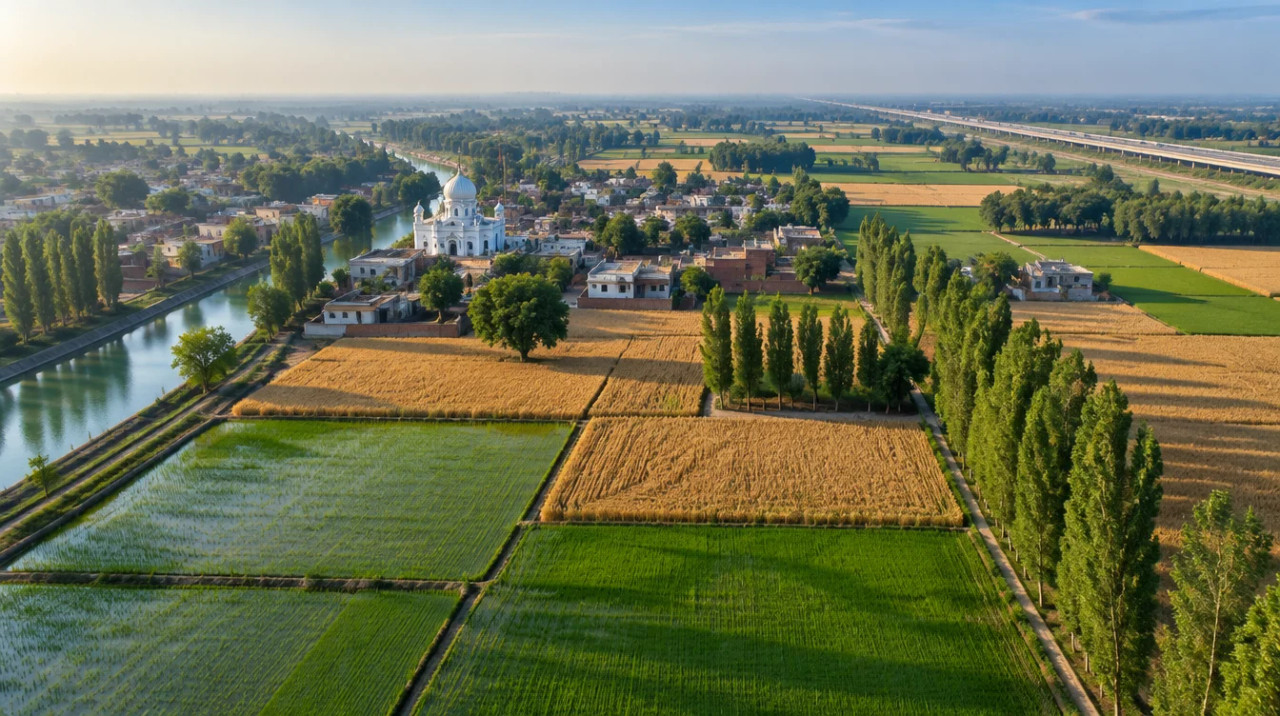
Kapurthala is one of Punjab's smaller districts: 1,633 sq km, 817,668 people at the 2011 Census (CGWB district plan), four tehsils (Kapurthala, Sultanpur Lodhi, Bhulath and Phagwara) and five blocks. The Beas forms its western edge and the Sutlej its southern edge, and the district portal lists paddy, wheat, sugarcane, groundnut and vegetables, with vegetables grown mainly in the Sirwal area of Phagwara (district portal). Searching for land in Kapurthala means choosing between Phagwara's highway belt, the interior farmland around Kapurthala and Bhulath, and the Beas-side villages of Sultanpur Lodhi, which are the most exposed to floods.
We publish no per-acre price for Kapurthala, because listing-site asking prices could not be traced to registered deals. Two reported signals exist. The Tribune named Kapurthala among 12 districts where collector rates rose by 5% to 50% by August 2025, without a district figure (The Tribune, August 2025). In June 2024 Phagwara traders said a new rate list had raised collector rates by 200% to 300%, with one locality moving from ₹35,000 to ₹1,00,000 per marla; the report does not name the district and the example is a locality rate, not farmland (The Tribune, June 2024).
The legal position for outside buyers is the same as in the rest of Punjab: a holding ceiling, no buyer-class clause in the text we read, and no farmland for NRIs or OCIs. The district-specific issue is flooding. The Beas breached the Aahli Kalan bund in August 2025 and the Mand area stood under water; the Tribune counted 35 villages and about 36,000 acres of paddy affected, on a figure given by Sant Balbir Singh Seechewal (The Tribune, 26 August 2025). A buyer of Beas-side land should treat flood history as a title-level check.
Road access is improving on paper. The four-lane Phagwara–Hoshiarpur highway was launched on 24 May 2025 with a two-year target (The Tribune). On the Delhi–Amritsar–Katra Expressway, NHAI terminated three Punjab packages in 2026, among them Package 10 on the Jalandhar–Moga to Jalandhar–Kapurthala section, and floated fresh tenders (The Tribune, May 2026). Price the roads that exist today.
- Doaba
- Beas flood plain
- Phagwara
- Sultanpur Lodhi
- Kapurthala town
- Bhulath
Transaction costs
Stamp duty & registration in Kapurthala
8%
Usual stamp duty — reported
The Tribune, 15 Jan 2026, on a concession for cooperative-society buyers
Not found
Women's and joint rates
No official or news source for a male/female split, so none is shown
1%
Registration fee — reported
Described as applying "as per rules"; the 2017-18 audit recorded a cap of ₹2 lakh
The one recent news figure is The Tribune, 15 January 2026, which said original allottees' buyers in cooperative societies would pay 1%, 2% and 3% in January, February and March 2026 instead of the usual 8%, with the registration fee still due. The Comptroller and Auditor General's report on Punjab's revenue sector recorded 5% duty, a 1% social infrastructure cess and a 1% registration fee capped at ₹2 lakh as in force in 2017-18 (CAG report, 2019); those rates have since changed. We opened no official Punjab rate page, and the combined rate for an ordinary land purchase, rural or urban, is not confirmed. Ask the Sub-Registrar for the figure before budgeting.
Duty is charged on the higher of the deal value and the collector rate. Collector rates were raised in August 2024 (Patiala up to 100% in places, per The Tribune, August 2024), and by August 2025 Kapurthala was among 12 districts with rises of 5% to 50% and no individual figure (The Tribune, August 2025). A further statewide rise was put on hold. We did not find the Kapurthala village-wise list, so look up the village before pricing an offer; Phagwara and the Beas-side villages may sit in very different bands. A rebate for women buyers existed in 2018, when an amendment reclaimed it if the land passed to a male relative within a year (The Statesman, June 2018); we found no current rate.
Know the belt
What is moving prices in Kapurthala
Several sub-markets inside a small district. We publish no listing-site prices; the notes below give reported rate movements and what to check.
Phagwara belt
No sourced per-acre price
No registered-deal or collector-rate price for Phagwara was found. The only dated rate figure is the June 2024 report of a locality moving from ₹35,000 to ₹1,00,000 per marla (The Tribune); it describes a town locality, not farmland.
Check: the khasra's district (Phagwara can be listed under Jalandhar), road frontage to the national highway, and the land-use class. Large blocks near the highway may be priced for roadside use rather than farming.
Beas-side villages (Sultanpur Lodhi, Mand)
No sourced price
We found no price for the Sultanpur Lodhi or Mand villages. These are the villages hit by the August 2025 floods, and a buyer should ask for the last three years of flood and crop-loss history before negotiating.
Check: the distance to the Beas and its bunds, the plot's height above the river bed and the jamabandi entry for the seller's name.
Kapurthala town and Bhulath
No sourced price
We found no price for Kapurthala town or Bhulath and do not give a band.
Check: a recent registered deed for a similar parcel from the Sub-Registrar.
Collector rates
Named, no figure
Kapurthala was one of 12 districts with collector-rate rises of 5% to 50% by August 2025, with no figure given for it, and a further statewide rise was put on hold (The Tribune). We did not find a village-wise list. Duty is paid on the higher of the deal value and the collector rate.
Check: the rate for the specific village before agreeing a price.
Units: acre, kanal, marla
Punjab sells farmland by the acre; 1 acre = 8 kanal and 1 kanal = 20 marla. Convert every quote to acres before comparing two offers, and recompute any per-acre figure from the total price and the area in the jamabandi.
Connectivity
How Kapurthala connects — road, rail and air
Distances are limited to what we could source from official pages and press; journey times vary with traffic, road works and floods.
By road
By air and rail
Flood-season access
For a buyer from Delhi the practical question is the last leg from the highway into the village, and whether that road floods. Neither the expressway nor the Hoshiarpur four-lane road is finished. Read the Punjab agricultural land rules before paying an advance.
Growth catalysts
Upcoming infrastructure & developments
Status labels reflect sources read in October 2026. Government-announced timelines are not guaranteed; items marked confirm have single or conflicting sources.
00Operational
03In progress or at risk
Dates uncertain
Agriculture & terrain
Soil, crops & water in Kapurthala
A small Doaba district of paddy, wheat and sugarcane along a river that flooded in 2025.
🌾 The Doaba plain
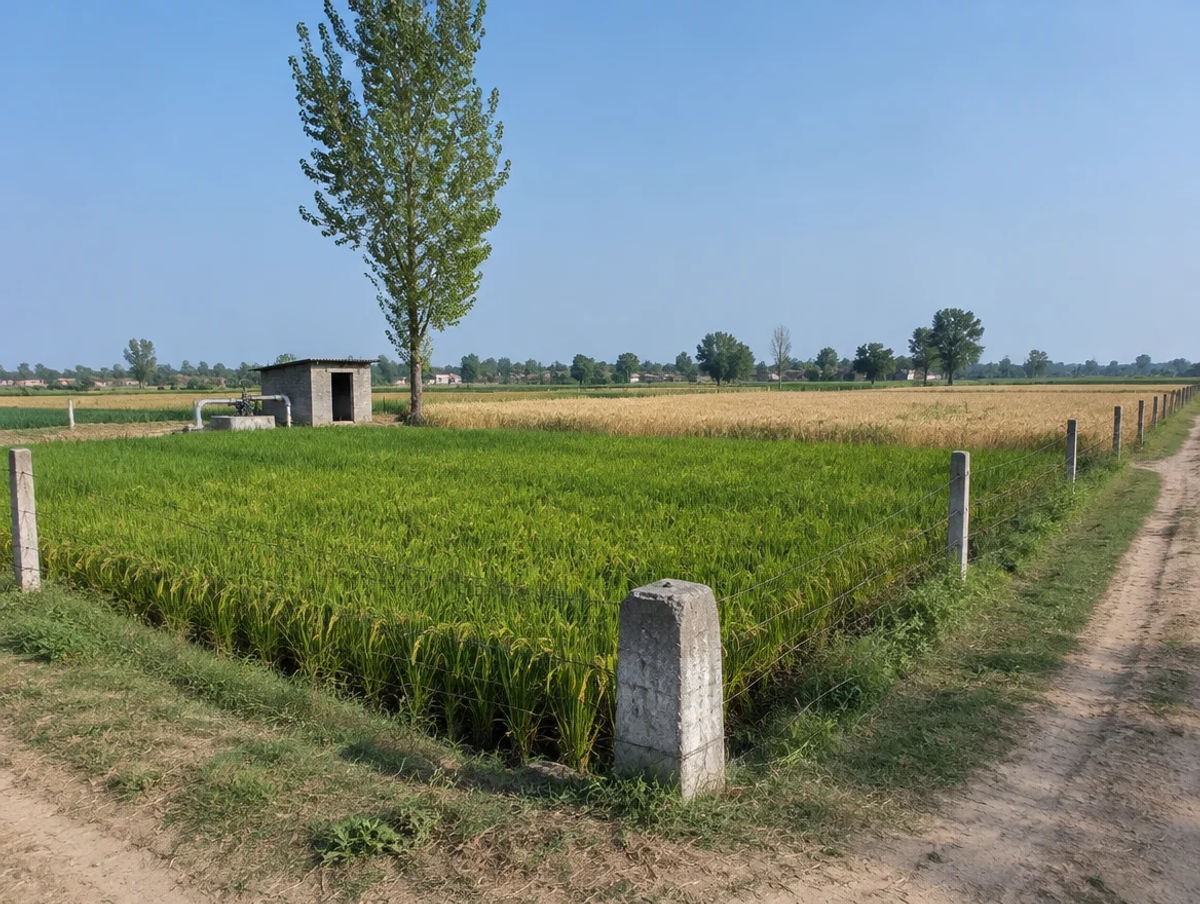
Kapurthala lies in the Doaba, with the Beas on its western edge and the Sutlej on its southern edge. The district portal lists paddy, wheat, sugarcane, groundnut and vegetables (district portal). The CGWB district plan puts normal rainfall at 779 mm a year and says tubewells are the main source of irrigation, about 54,125 of them, with roughly 86% of the water moving through unlined open channels (CGWB; data about 2015). We did not read a soil survey for the district.
- Paddy
- Fodder
- Irrigated plain
🌊 The Beas and the August 2025 floods
On 16 August 2025 the Beas at Sultanpur Lodhi was at 1.08 lakh cusecs after peaking at 1.25 lakh, with about 57,000 cusecs released from the Pong Dam; more than 500 villagers were evacuated from Baupur in the Mand area, and Baupur, Baupur Kadim, Jadid and Sangra were among the worst hit (The Week/PTI). India Water Portal also lists parts of Kapurthala among the waterlogged areas in September 2025 (India Water Portal). Check any Beas-side parcel against the river and bunds, ask for flood and crop-loss history, and keep a flood buffer in the price.
- Beas
- Mand villages
- Sultanpur Lodhi
🏭 Phagwara belt
Phagwara lies on the Grand Trunk Road (district portal). Land along the highway may be priced for roadside use rather than farming, so ask for the land-use class and any change-of-land-use order before paying a farmland price.
- Phagwara
- NH-44
💧 Groundwater and rainfall
The CGWB district plan, using 2011 resource data, classed all five blocks as over-exploited with a district stage of extraction of 234% (Phagwara 364%, Sultanpur Lodhi 246%) (CGWB, district plan). Statewide, CGWB's December 2024 report gives 156.87% with 115 of 153 assessment units over-exploited (CGWB Punjab 2024), and PIB gives 156.36% for the 2025 national assessment (PIB, 18 December 2025). The 2024 report has no block table, so we state no current block category for Kapurthala. Ask for the block category and borewell depth for the village.
📐 Units and mandi prices
Punjab sells land by the acre, kanal and marla (1 acre = 8 kanal; 1 kanal = 20 marla). Crop income is modest next to what land can be priced at near a highway, so price a parcel on location, flood history and permitted use, not yield.
At a glance
Kapurthala vs. its neighbours
| District / belt | Sourced price signal | Evidence |
|---|---|---|
| Kapurthala | No per-acre price sourced | One of 12 districts with 5% to 50% collector-rate rises (The Tribune, Aug 2025); no figure given |
| Jalandhar | No per-acre price sourced | City 5% and Nurmahal 20% (The Tribune, Aug 2025) |
| Ludhiana | No per-acre price sourced | 25% to 40% rise proposed, awaiting approval (The Tribune, Aug 2025) |
| Hoshiarpur | No per-acre price sourced | City rates up 20% (The Tribune, Aug 2025) |
We publish no sourced per-acre price series for any of these districts; the figures above are reported collector-rate movements, which are percentages and not rupee levels, and they are not like-for-like. See the Jalandhar, Ludhiana and Hoshiarpur pages for the neighbouring markets.
Farmland India view
Why investors look at Kapurthala
Four reasoned points, with an honest note that the evidence is thin and flood risk decides much of the district.
An open market, with no price series
We found no clause barring outsiders from agricultural land, and collector rates have moved in Kapurthala, but no registered-deal price is published, so we cannot say how the district compares with its neighbours. Treat any quoted comparison with Ludhiana as unproven.
Highway access at Phagwara
Phagwara is on the Grand Trunk Road and the new Phagwara–Hoshiarpur road starts there. If it is delivered on time, access improves; if not, the premium has not been earned.
Paperwork carries the price
Joint holdings and sellers living abroad make the paperwork heavier. A buyer who checks the jamabandi, the mutation chain and the registered power of attorney is ahead of most.
Flood history as a price signal
Beas-side land that flooded in 2025 should be priced with a discount for risk, if you buy it at all. Land on the interior side of the bunds is a different product.
Confirm land class, title, flood and forest status directly; these are not certified by Farmland India’s review.
STRAIGHT TALK
Risks & challenges in Kapurthala
Read these before shortlisting in Kapurthala specifically.
Beas flood risk
A bund at Aahli Kalan breached in August 2025 and the Mand area flooded. Check distance to the river, bund condition and flood history.
Relief is assessed on the record
The state ordered a special girdawari after the floods and reported crop compensation of ₹20,000 per acre (The Tribune, October 2025). Make sure the seller's name is on the current jamabandi and mutate your purchase promptly.
Shamlat Deh and joint holdings
Village common land vests in the panchayat and a private seller cannot pass title to it; joint khatas are common. Match every khasra to the jamabandi.
Unapproved colonies and the NOC
Plots in unapproved colonies are a standing risk; The Tribune reported the High Court struck down the NOC waiver in April 2025, and we have not read the order. Ask the Sub-Registrar what is now required.
No sourced price series
We found no registered-deal or collector-rate figure for farmland in Kapurthala. Collect registered comparables for the village before you offer.
Announced is not delivered
The Phagwara–Hoshiarpur road has a two-year target from May 2025, and NHAI terminated three expressway packages in 2026, one of them on the Kapurthala side. Price today's roads.
Who to contact
Local revenue, planning & forest offices
Mutation and record matters go through the Patwari and the Tehsildar of the relevant tehsil (Kapurthala, Bhulath, Phagwara or Sultanpur Lodhi, as listed on the district portal). Shamlat Deh and land-class questions are raised with the Patwari and Tehsildar. For layout and building approvals, ask the District Town Planner which authority and which plan covers the village.
Sale-deed registration is handled by the Sub-Registrar, who also gives the collector rate for the village. Search the jamabandi and khasra on the Punjab Land Records Society portal, and ask the Irrigation and Drainage department for flood-protection records for Beas-side villages. This is a general guide, not legal advice.
KEEP EXPLORING
Explore more areas
Micro-markets in Kapurthala
Other districts in Punjab
Guides & research
- Kanal and Marla in Haryana and Punjab — Conversion GuideWiki · P01 Land Measurement Units
- Punjab Agricultural Land RulesWiki · P04 State-wise Land Laws
- Marla, Kanal and Killa in Punjab — What They MeanWiki · P01 Land Measurement Units
- Farmhouse Rules in Punjab (2026): Mohali and PAPRAWiki · P17 Farmhouse & Lifestyle Land
- Stamp Duty Calculator Punjab: Land Cost Method (2026)Wiki · P11 Taxation, Stamp Duty & Registration
- Bhu Naksha Punjab: Village Land Map Guide (2026)Wiki · P02 Land Records & Documentation
- Stamp Duty Punjab: Land Registry Charges (2026)Wiki · P11 Taxation, Stamp Duty & Registration
- Punjab CLU: Change of Land Use Explained (2026)Wiki · P06 Land Use, CLU & NA Conversion
COMMON QUESTIONS
Frequently asked questions
Everything buyers, NRIs and investors ask before their first reviewed farmland purchase in Kapurthala.
Visit full wiki01 of 04
Can an outsider buy agricultural land in Kapurthala?
On the text we read, yes. Section 4 of the Punjab Land Reforms Act, 1972 caps what a family may hold (7 hectares of two-crop irrigated land, 11 hectares of one-crop irrigated land, 20.5 hectares of barani land) and we found no clause limiting who may buy. NRIs and OCIs cannot buy agricultural land under the RBI's FEMA Master Direction. The Act copy is a 2005 printout, so confirm with a Punjab revenue lawyer.
02 of 04
What does agricultural land cost in Kapurthala?
We publish no per-acre price, because listing-site asking prices could not be traced to registered deals. The Tribune reported that Kapurthala was among 12 districts with collector-rate rises of 5% to 50% by August 2025, with no figure for it. Check the village's collector rate and a recent registered deed at the Sub-Registrar.
03 of 04
Did the 2025 floods affect land in Kapurthala?
Yes. In August 2025 the Beas flooded more than 20 villages in Sultanpur Lodhi and the Mand area (The Week/PTI), and a bund at Aahli Kalan breached, with 35 villages and about 36,000 acres of paddy reported affected (The Tribune). Check the distance to the river, the bund condition and flood history before buying nearby.
04 of 04
Is Phagwara in Jalandhar or Kapurthala district?
Kapurthala. The district portal lists Phagwara as one of its four tehsils. Phagwara sits on the Jalandhar road and is often listed with Jalandhar, so confirm the district on the khasra and use the Kapurthala Sub-Registrar and collector rate.
Transparency
Sources and references
Law and courts
- Punjab Land Reforms Act, 1972 (ss. 4, 12), Punjab Land Records Society
- Punjab Village Common Lands (Regulation) Act, 1961, India Code
- Suraj Lamp & Industries v State of Haryana, Supreme Court, 11 Oct 2011
- PAPRA Amendment Bill 2024 (Bill 7-PLA-2024), gazetted text on PRS
Government
- Master Direction FED 12/2015-16 on immovable assets under FEMA, Reserve Bank of India, updated 1 Sep 2022
- Stamp duty chapter, Report No. 3 of 2019 (Revenue Sector, Punjab), Comptroller and Auditor General
- Dynamic Ground Water Resources and Ground Water Quality of Punjab, 2024, Central Ground Water Board, December 2024
- Ground water assessment 2025, Press Information Bureau, 18 Dec 2025
- Land Pooling Policy 2025 page, GMADA (policy dated 4 Jun 2025, amendment 25 Jul 2025)
- National highway projects in Punjab, Rajya Sabha reply, Press Information Bureau, 7 Feb 2024
- First commercial flight lands at Halwara, All India Radio, 15 May 2026
- Kapurthala district profile, Kapurthala district portal, opened October 2026
- Plan on artificial recharge in over-exploited blocks of Kapurthala district, Central Ground Water Board (data to about 2015)
News
- Stamp duty relief: original allottees exempt, 1% duty for buyers till Jan 31, The Tribune, 15 Jan 2026
- Cash-strapped state hikes collector rates, The Tribune, 8 Aug 2024
- Proposals to raise collector rates put on back burner, The Tribune, 13 Aug 2025
- Punjab amends rule to bar misuse of stamp duty rebate for women, The Statesman, 18 Jun 2018
- High Court disposes of pleas against the land pooling policy as infructuous, The Tribune, 11 Sep 2025
- Why Punjab keeps rewriting its land pooling policy, The Tribune, 24 Jun 2026
- Regularisation of 30k illegal colonies sparks fears of haphazard urbanisation, The Tribune, 15 May 2025
- Government rolls out Easy Jamabandi portal, The Tribune, 13 Jun 2025
- Barring Punjab, Delhi-Katra e-way almost complete in most states, The Tribune, 23 Aug 2024
- NHAI terminates 3 Delhi-Amritsar-Katra packages, The Tribune, 2 May 2026
- Expedite work on Delhi-Katra expressway: DC, The Tribune, 5 Nov 2020
- Phagwara-Hoshiarpur four-lane project launched in Phagwara, The Tribune, 24 May 2025
- Phagwara dealers demand rollback of collector-rate hike, The Tribune, 19 Jun 2024
- Beas floods villages in Punjab, The Week (PTI), 16 Aug 2025
- Swollen Beas hits 35 villages, The Tribune, 26 Aug 2025
- Govt orders special girdawari in Kapurthala's flood-hit areas, The Tribune, 2025
- Minister launches compensation distribution for flood-affected farmers, The Tribune, 16 Oct 2025
- FAQ on Punjab floods, September 2025, India Water Portal, 7 Sep 2025
Further reading
- Punjab flood damage, Rajya Sabha reply, Ministry of Home Affairs, 3 Dec 2025
- Balance-for-award list, National Highways Authority of India, 1 Mar 2026
- Punjab Land Reforms (Amendment) Bill 2017 (33-PLA-2017), Punjab Vidhan Sabha
- Punjab Basic Statistics, Government of Punjab
- Agriculture Land Use Statistics for 5 Years, Punjab Department of Agriculture
- Centre starts process to move border fencing in Punjab, All India Radio, 13 Apr 2026
- Ludhiana-Bathinda Expressway, information and status, The Metro Rail Guy (page updated 8 Jul 2024)
- Punjab groundwater crisis: canals being sought as a solution, Down To Earth, 4 Sep 2026
Data-currency note: the population figure is Census 2011 as quoted in a CGWB plan whose data run to about 2015. Road, expressway and flood statuses were read in October 2026 and change quickly. The stamp-duty figures are the last we found; no official current rate schedule, collector-rate list or revenue page opened for us. Acts were read in the versions linked. This is a general guide, not legal advice. Report inaccuracies to wiki@farmlandindia.com.
For developers
Ready to explore Kapurthala farmland?
Browse reviewed projects and individual land parcels across Kapurthala — or if you own land here, list it with platform review and reach serious buyers.